Sima Lozanić
(1847–1935)
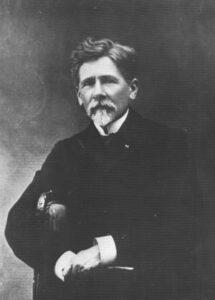
A Serbian chemist, academic, prominent politician and diplomat. He was a professor and rector of the Great School, the first rector of the newly founded University of Belgrade, president of the Serbian Royal Academy, envoy to London, minister of national economy and foreign affairs, and one of the most distinguished Serbian scientists at the turn of the 20th century.
Early Life and Education
Lozanić was born in Belgrade on 8 March 1847. His father, Miloje, held the position of district governor in various regions of Serbia, which led to Lozanić pursuing his primary education across Kladovo, Paraćin, and Belgrade. He subsequently undertook his secondary education in Negotin, Zaječar, Belgrade, and Kragujevac. His mother, Ana, was a longstanding president of the Belgrade Women’s Society.
He graduated from the Faculty of Law at the Great School in Belgrade in 1868. Shortly after completing his degree, he enrolled in the Pedagogical Academy in Kiesnacht (near Zurich) as a scholarship student of the Serbian government, though his interests increasingly gravitated toward the natural sciences. Over the next four years, he pursued parallel studies in chemistry. During his first semester, he attended lectures in experimental physiology and physics at the University of Zurich. The following year, he studied chemistry under the renowned professor Wislicenus. In 1870, he moved to Berlin to continue his studies under Hofmann, one of the leading researchers in organic chemistry at the time. While still a student in Berlin, he published two papers on organic chemistry in a German journal and was admitted as a member of the German Chemical Society.
Academic and Pedagogical Work, Textbooks
Upon his return to Belgrade, on the recommendation of Josif Pančić, then rector of the Great School, he was initially appointed as an assistant in chemistry and chemical technology in 1872, and subsequently as a full professor at the Great School (1874–1894). His arrival marked the beginning of a modern era in the development of chemistry in Serbia. In a short period, Lozanić fundamentally transformed the teaching of chemistry, drawing upon the most advanced knowledge he had acquired in renowned European laboratories of the time. He consolidated this knowledge in his textbooks on organic chemistry (1874, 1880, 1893) and inorganic chemistry (1875, 1883), chemical technology (1887, 1892, 1894), and chemical practicals (including translations of Wislicenus’s laboratory manual in 1873 and 1879, and Hofmann’s classification in 1875), and integrated it into the curriculum through his pedagogical work. These textbooks were distinguished by their application of structural theory, a new classification of elements, modern classification of organic compounds, and the introduction of updated nomenclature. They were significant on multiple levels: for their carefully selected content, scientific and professional value, clarity in methodological approach, and precision of language.
Sima Lozanić was both the creator and the founder of modern chemical terminology in Serbian science, as well as a pioneer of experimental chemistry education, having established a program of mandatory laboratory exercises. His textbook on inorganic chemistry was the first university-level textbook outside of contemporary Russia to reference Mendeleev’s periodic system of elements.
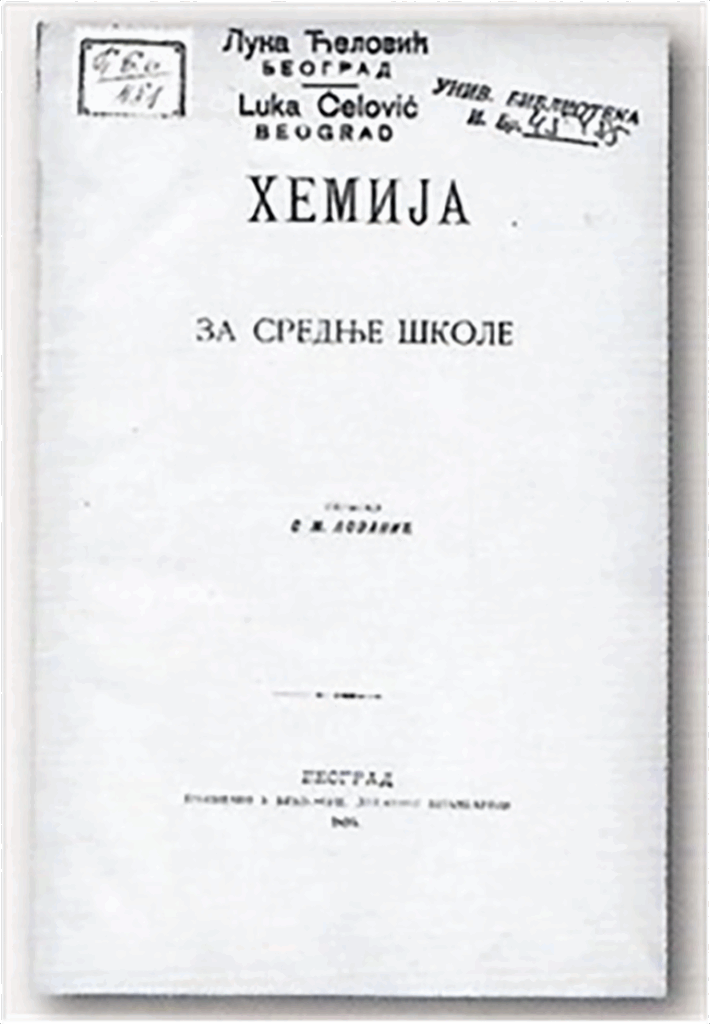
In addition to his higher education textbooks, Lozanić authored the first modern chemistry textbook for secondary schools, which, in terms of structure, scientific rigor, and pedagogical value, surpassed all previously written works. It was published in 1895 and went through several editions (1897, 1903, 1910, 1921, 1925), each supplemented with the latest scientific knowledge. In the introduction, Lozanić emphasized: ‘(…) I have taken care to derive all chemical concepts from experiments. (…) Chemistry teaching is most modern when each student conducts the experiments independently.’
Over the course of sixty years of scientific work, he published more than two hundred scientific and professional papers. Among the international scientific community, his most influential works were in the fields of organic chemistry and electro-synthesis.
He was elected rector of the Great School in 1890 and at that time already raised the issue of its reorganization into a university. However, due to the unstable political situation, this matter was postponed until the beginning of 1905.
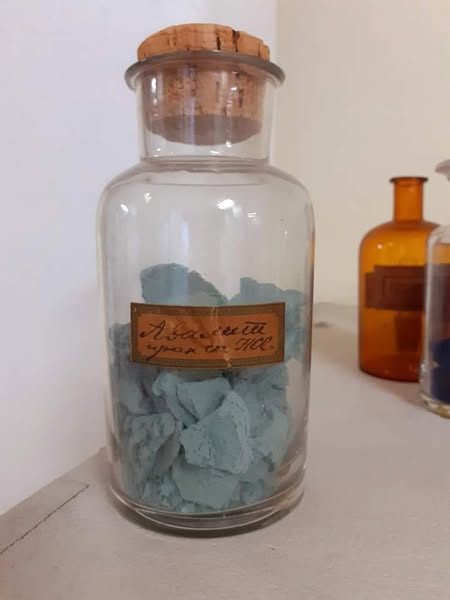
Avalite, a mineral discovered by Sima Lozanić in 1884
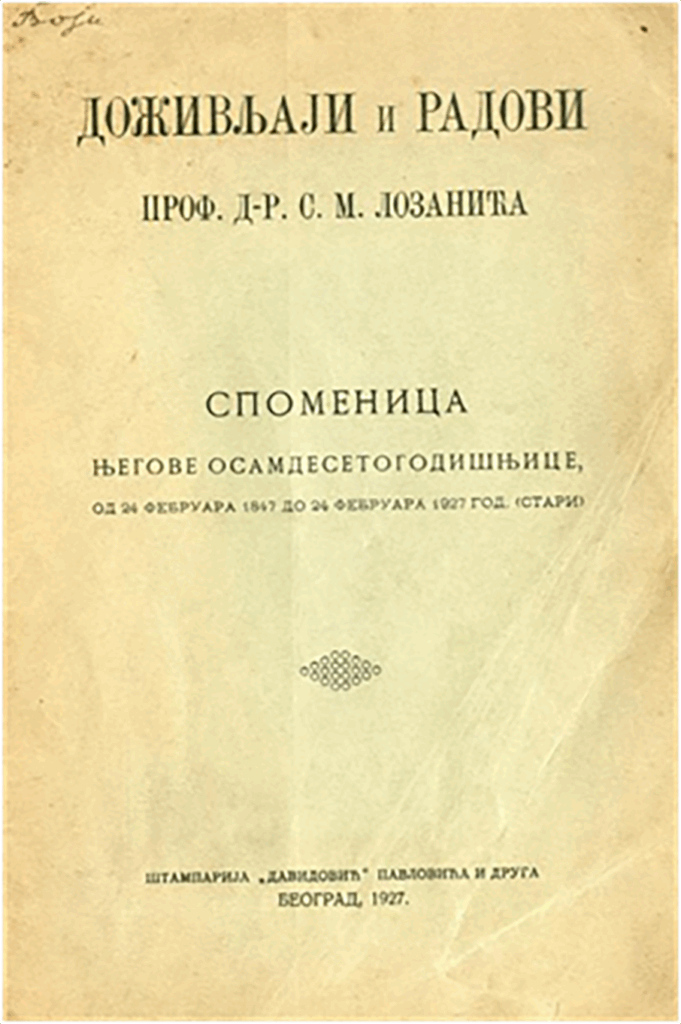
Experiences and Works, Prof. Dr. S. M. Lozanić
Work in Applied Chemistry
Sima Lozanić made significant contributions to the field of analytical chemistry. He devoted particular attention to the study of Serbia’s natural resources, examining its mineral wealth, minerals, mineral waters, and soil. He was the first to professionally analyze the mineral waters of Serbian spas (from 1874 to 1886, he analyzed the waters of 11 spas), highlighting their therapeutic properties and potential for the development of domestic tourism.
Among his most important analytical achievements was the discovery and determination of the composition of three previously unknown minerals: miloshinite, alexandrolite, and avalite (1884). He also analyzed the drinking water from Belgrade fountains, and upon finding it unfit for consumption, he prompted the relevant authorities to take action. Consequently, the municipal president, Nikola Pašić, ordered the construction of a new water supply system and the renovation of the existing water supply system.
Public Service and Contribution to the Development of the Serbian Economy
Sima Lozanić devoted a period of his life to politics. Upon entering political life, he did not engage in academic duties for the next eleven years, instead holding several high governmental positions—three times as Minister of Economy (1894, 1895, and 1897), as Minister of Foreign Affairs (1894 and 1902), and as envoy to London (1900). In early 1894, he joined the government of Đorđe Simić as Minister of Economy. During his third term (1897–1899), he devised a far-reaching plan for the accelerated development of specific economic sectors and promoted the industrialization of the country. Within the framework of this plan, important laws were enacted concerning agricultural stations, state-managed agricultural enterprises, the advancement of fruit growing, the advancement of animal husbandry, pest control, hunting, fishing, forestry, agricultural cooperatives, the improvement of fund administration, the telegraph and telephone, and the support of state industry.
At the turn of the 20th century, Lozanić advocated the use of artificial fertilizers in agriculture. He organized a series of vegetation experiments in the Pomoravlje, Posavina, and Podunavlje regions. Although these experiments demonstrated a significant increase in crop yields, his progressive ideas were not immediately accepted. The widespread use of artificial fertilizers in Serbia began only half a century later.
His work on economic issues was also reflected in his ten-year effort to establish the Agricultural Department at the Faculty of Philosophy as a ‘future center of agricultural science,’ where a ‘transformation of our backward economy’ would take place and allow it ‘to reach the level of science.’ He emphasized the need for agricultural problems to be studied at a scientific level.
The First Rector of the University of Belgrade
Following the founding of the University in 1905, Sima Lozanić, as the most senior and esteemed professor, was elected its first rector. He returned to teaching and continued modernizing the teaching of chemistry. In 1922, he became the first professor in the history of the University of Belgrade to receive an honorary doctorate from the Faculty of Philosophy.
As the first rector of the University, he played a key role in its institutional development. Upon taking office, he stated the following in his inaugural address:
“Our former belief that Serbdom would be united not by the bukvar (first reading book), but by the sword, proved disastrous for our national consciousness. I believe the opposite: that education will be the primary force in resolving this crucial issue, and that it would already have been resolved had we nurtured education more effectively. I hold this belief because education is the power that shapes all the directions of a nation. Had our education been more advanced, every aspect of our nation’s life would have been more complete, and even more successful.“
He emphasized that in all advanced countries, ‘universities guide both state and national life.’
“…To be truly devoted to one’s science and to conscientiously pursue scientific truths are the qualities of a university citizen as a scholar; to be unwavering in character and to cultivate virtues consistently are the qualities of a university citizen as a human being; and to love one’s homeland above all, being willing to sacrifice even one’s life for it, are the qualities of a university citizen as a son of a nation. I believe that our University will also be able to foster such a spirit in its citizens…”
– Lozanić at the Inaugural Opening
of the University of Belgrade, 2 October 1905
True Patriot
Sima Lozanić witnessed numerous wars and was an active participant in many of them—from the Serbian-Turkish Wars (1876–1878, 1885) and the Balkan Wars to the First World War. During the Serbian-Turkish conflicts, he served as the manager of the Topolivnica at the Military Factory in Kragujevac, and in 1885 he acted as a road inspector. During the First World War, nearly seventy years old, Lozanić crossed Albania with the Serbian army. Drawing on his professional expertise as well as his political and diplomatic experience, he advocated for aid to the Serbian people in the devastated country. He was one of the founders of the Economic Committee in Geneva and was later appointed as the Serbian delegate to the Anglo-French-Russian Commission for the Provisioning of Prisoners.
He was also a member of the Serbian mission to the United States in 1917, aimed at securing political support and economic assistance for the country
Honors
During his lifetime, Sima Lozanić received praise, honors, and recognition. He was elected a member of numerous domestic and international scientific institutions and societies. He became a member of the Serbian Learned Society in 1873, the Serbian Medical Society in 1874, and the Romanian Society of Sciences in 1899. He was elected a corresponding member of the Serbian Royal Academy in 1888 and became a full member in 1890. On two occasions, he served as president of the Serbian Royal Academy (1899–1900, 1903–1906). Lozanić was also a member of many other domestic and international scientific societies and served as honorary president of the Serbian Chemical Society in 1922. In 1925, he was elected a corresponding member of the JAZU (Yugoslav Academy of Sciences and Arts) and the Czech Academy of Sciences.
For his public and political work and exceptional patriotism, he was awarded numerous honors: the Silver Medal for Bravery (1876), the Veterans’ Commemorative Medal (1876), the Order of St. Sava, Third Class (1889), the Order of Miloš the Great, Third Class (1899), the Romanian Crown, First Class (1907), the Order of St. Sava, First Class (1922), and others.
The Departure of “the Spirit Stronger than Matter” into Eternity
A tireless and restless worker, he passed away on July 7, 1935, in Belgrade. He was 88 years old. On behalf of the Serbian Academy of Sciences, Bogdan Gavrilović bid farewell to Lozanić with the words: “To the worker without equal and the first knight of our science,” who, according to Gavrilović’s testimony, had declared just a few months before his death: “Even so, the spirit is stronger than matter.”
Sima Lozanić, one among the great figures of science and culture, left an indelible mark on our science, while his pedagogical and political work contributed immeasurably to the development of Serbia’s state institutions, science, education, economy, and industry.
“Just as the sun, with its rays of light, heat, and chemical energy, gives life to lifeless nature (…), so too does the school, with its rays of knowledge, give life to the human spirit, enabling the unenlightened child of cold nature to develop his mind, and allowing that simple living creature to become a cultured human being.”
References
Click for more
Doživljaji i radovi prof. dr S. M. Lozanića, Spomenica njegove osamdesetogodišnjice, od 24. februara 1847. do 24. februara 1927. god. (stari) Beograd: Štamparija „Davidović“ Pavlovića i druga, 1927.
Snežana Bojović, „Sima Lozanić (1847–1935)“, Život i delo srpskih naučnika, Beograd: SANU, 1996, str. 199–262.
Snežana Bojović, Sima Lozanić 1847–1935, Beograd: Princip, 1996.
Marija Vranić-Ignjačević, Dragana Stolić i Dubravka Milošević, „Sima Lozanić: 1847–1935: prvi rektor Beogradskog univerziteta: katalog izložbe“. Beograd: Univerzitetska biblioteka „Svetozar Marković“, 2005.
Snežana Bojović, 200 godina Beogradskog univerziteta: 1808-2008: istorija institucije, Beograd, 2008.
„Sima Lozanić: doprinos nauci, obrazovanju, privredi i društvu: zbornik radova sa naučnog skupa održanog 10. i 11. maja 2023. godine“, (urednik Bogdan Šolaja), Beograd: SANU, 2024.
Selected Bibliography
This overview, covering only a small portion of Sima Lozanić’s extensive bibliography, aims to showcase the diversity of his work. In addition to scientific papers in organic chemistry and electrosynthesis, Lozanić was deeply engaged in applying theoretical knowledge to agriculture, conducting various chemical analyses important for public health, delivering lectures for general audiences, and even contributing to military science by sharing his personal experience from the Serbian-Turkish War while working on mine deactivation.
A more complete bibliography of Sima Lozanić is available in the publication Sima Lozanić 1847–1935: The First Rector of Belgrade University: Exhibition Catalogue (authors Marija Vranić-Ignjačević, Dragana Stolić, Dubravka Milošević), published in 2005 (call number in the University Library collection II 74158).
Click for more
Hemija sa gledišta moderne teorije. Deo 1, Neorganska hemija / izradio S. M. Lozanić. – U Beogradu : Štampa i izdanje državne štamparije, 1874. – 411 str., [1] presav. list : ilustr. ; 20cm
PB11 80/1
Kritika na kritiku ili Odgovor na kritiku moje hemije u „Budućnosti“ / S. M. Lozanić. – Beograd : Državna štamparija, 1875. – 16 str. ; 23 cm
H 16
Hemija sa gledišta moderne teorije. Deo 1, Neorganska hemija : sa 70 drvoreza u tekstu i jednom spektralnom tablom / izradio S. M. Lozanić. – 2. prerađeno i uvećano izd. – U Beogradu: Izdanje i štampa Državne štamparije, 1880. – 695 str., [4] lista s tablama : ilustr. ; 22 cm
H 152/1
Analize srpskog fosilnog uglja / S. M. Lozanića. – Beograd : Državna štamparija, 1881. –16 str. ; 24 cm
P.o.: Glasnik ; 50.
N 117
Analize beogradskih i topčiderskih pijaćih voda, mineralnih voda po Srbiji i srpskog fosilnog uglja / od S. M. Lozanića. – U Beogradu : Kraljevsko-srpska državna štamparija, 1886. – [2], II, 60 str ; 24 cm
BH 4
Hemiska tehnologija. Deo 1, O vodi i gorivu / izradio S. M. Lozanić. – U Beogradu : Izdanje i štampa Kralj.-srp. državne štamparije, 1887. – VIII, 176 str. : ilustr. ; 23 cm.
H 3
Sveta veština i alhemija : javno predavanje Sime Lozanića : držano u dvorani Velike škole januara 1889. – U Beogradu : Kraljevsko-srpska državna štamparija, 1889. – [2], 29, [2] ; 24 cm. – (Javna predavanja na Velikoj školi. 1 kolo ; 5)
P. o.: Otadžbina ; knj. 21.
PB15 613
Istorija poimanja hemiskih elemenata i reformacija hemije : javno predavanje S. M. Lozanića : držano u dvorani Velike škole 4. marta 1890. – U Beogradu : u štampariji Kraljevine Srbije, 1890. – [2], 29, [2] str. ; 24 cm
P. o. : Otadžbina ; knj. 25.
BH 20
O aromatičnim ditijokarbamatima : saopšteno u svečanoj sednici Akademije 4. novembra 1890 / od S. [Sime] M. Lozanića. – U Beogradu : U Srpskoj kraljevskoj državnoj štampariji, 1890. – 27 str. ; 24 cm. – (Glas / Kraljevska srpska akademija ; 27. [Razred 1, Prirodno matematičke nauke] ; [knj. 11])
PČ I 3/27
Hemija sa gledišta moderne teorije. Deo 1, Neorganska hemija / izradio S. M. Lozanić. – 3. popravljenjo i popunjeno izd. – U Beogradu : Izdanje i štampa Kralj.-srpske državne štamparije, 1893.– 408 str. : ilustr. ; 24 cm
H 85
Milošin, aleksandrolit i avalit / od S. M. Lozanića. Traktorija kruga pri stalnoj razdaljini / od Kolomana pl. Sili-a. – U Beogradu : Štampano u Kralj.-srpskoj državnoj štampariji, 1894. – 23 str., [1] presavijen list s tablama ; 24 cm. – (Glas / Srpska kraljevska akademija ; 41)
PB 397
Hemija : za srednje škole / napisao S. M. Lozanić. – Beograd : Kralj.-Srp. Državna štamparija, 1895. – 162 str. : ilustr. ; 24 cm
PB6 481
Hemija : za srednje škole / napisao S. M. Lozanić. – 2. popravljeno izdanje. – Beograd : štampano u Drž. štampariji Kraljevine Srbije, 1897. – [4], 175, [1] str. : ilustr. ; 23 cm
PB11 135
Izveštaj o ogledima s veštačkim đubretom u Srbiji : 1903. godine / od S. M. Lozanića. – Beograd : Glavni Savez srpskih zemljoraničkih zadruga, 1903. – [2], 71 str. : ilustr. ; 24 cm. – (Izdanja Glavnog Saveza srpskih zemljoradničkih zadruga ; sv. 31)
А 97/31
Hemija za srednje škole / napisao S. M. Lozanić. – 3. prerađeno i popunjeno izd. – Beograd : Štampano u državnoj štampariji Kraljevine Srbije, 1903. – IV, 207, [1] str. : ilustr. ; 24 cm
Ša 820
O kukuruzu kao hrani / od S. M. Lozanića. – Beograd : Glavni Savez Srpskih Zemljoradničkih Zadruga, 1904. – 23 str. ; 24 cm. – (Izdanje Glavnoga Saveza srpskih zemljoradničkih zadruga ; 35)
P. o.: Zemljoradnička zadruga ; 1904.
A 97/35
Međe periodnoga sistema hemiskih elemenata / od S. M. Lozanića. – [B. m. : b. i., 1905]. – 30 str. ; 24 cm
P. o.: Glas Srpske kraljevske akademije ; 69.
BH 16/69
Minski radovi u Srpsko-turskom ratu 1876. godine / od S. M. Lozanića. – Beograd : Štamparija „Dositije Obradović“, 1905. – 32 str. ; 23 cm
P. o.: Ratnik.
BV 20
Značaj nauke za poljsku privredu : govor o sv. Savi 1906 godine / S. M. Lozanića. – Beograd : Štamparija „Dositije Obradović“, 1906. – 18 str. ; 23 cm
BŠs 152
Uputstvo za izvođenje vegetacionih ogleda pomoću veštačkog đubreta / od S. M. Lozanića. 2 uvećano izd. – Beograd : Glavni savez srpskih zemljoradničkih zadruga, 1906. – 41 str. : ilustr.; 24 cm. – (Izdanje Glavnoga Saveza srpskih zemljoradničkih zadruga ; 22)
А 97/22
O elektrosintezama : (drugo saopštenje) : (prikazano na skupu Akademije prirodnih nauka 19. juna 1907.) / od S. M. Lozanića. – Beograd : [b. i.], 1907. – Str. [253]–285 : ilustr. ; 23 cm
P. o. : Glas Srpske kraljevske akademije ; br. 73.
BH 15/ 73
Izveštaj o velikim poljoprivrednim školama / od S. M. Lozanića. – Beograd : Štamparija D. Dimitrijevića, 1909. – 42 str. ; 24 cm
BIi 317
Konzervisanje (čuvanje) ljudske hrane / S. M. Lozanić. – U Beogradu : U Državnoj štampariji Kraljevine Srbije, 1909. – 23 str. ; 24 cm
P. o.: Zemljoradnička zadruga ; knj. 5.
BA 53
O elektrosintezama u vakumu : (deveto saopštenje) : iz I Hemiskog instituta Univerziteta u Beogradu : (prikazano na skupu Akademije Prirodnih Nauka 31. dekembra 1912.) / od S. M. Lozanića. – U Beogradu : Državna štamparija Kraljevine Srbije, 1913. – Str. [179]-227 :
ilustr. ; 23 cm
P. o.: Glas ; br. 89.
BH 9
O ditijokarbhidracidima : prvo saopštenje / od S. M. Lozanića. – Beograd : Srpska kraljevska akademija, 1921. – Str. [79]-88 ; 24 cm
P. o.: Glas Srpske kraljevske akademije ; 95, 1921.
BH 14/95
O ditijokarbhidracidima : drugo saopštenje / od S. M. Lozanića. – Beograd : Srpska kraljevska akademija, 1922. – 11 str. ; 23 cm
P. o.: Glas Srpske kraljevske akademije ; 103, 1922.
BH 14/103
Lavoazije kao reformator hemije : predavanje na Narod. Univerz. držano 16. marta o. g. / od S. M. Lozanića. – Novi Sad : Jovanović i Bogdanov, 1925. – 12 str. ; 22 cm
P. o.: Glas apotekarstva ; br. 4, 1925.
BŠs 52