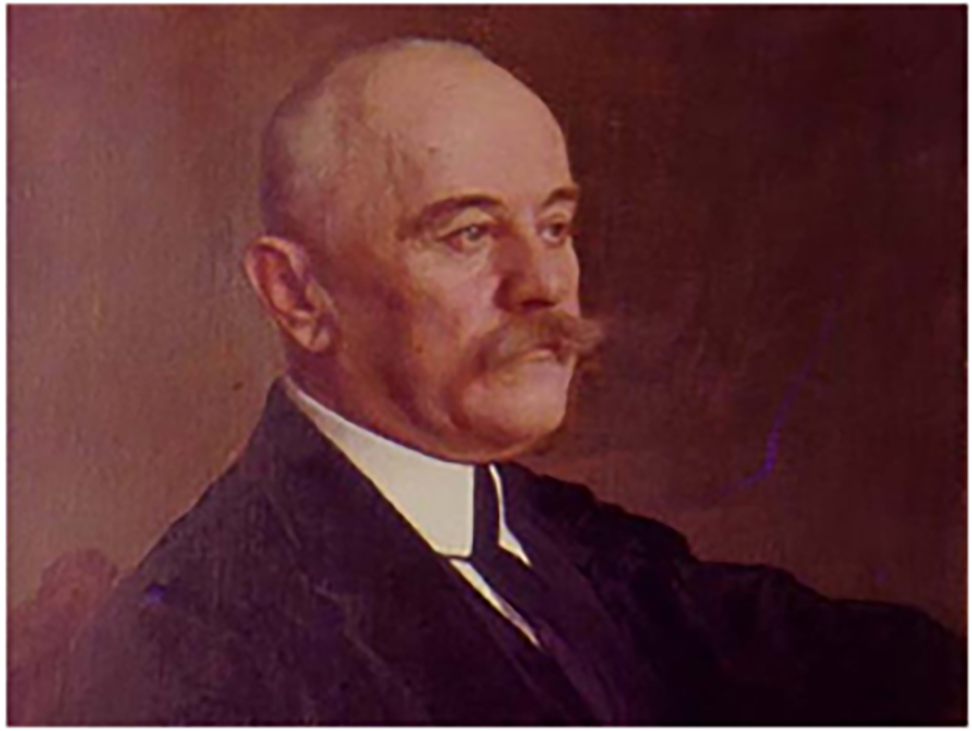
Jovan Cvijić
(1865–1927)
A world-renowned Serbian geographer, founder and establisher of scientific geomorphology, ethnologist, professor and rector of Belgrade University, president of the Serbian Royal Academy, and a leader in the study of the Balkan Peninsula. His research on soil characteristics, relief, hydrography, and ethnic groups left a lasting mark on Serbian and world science.
Childhood and Education
He was born on October 12, 1865, in Loznica. One of five children of his father Todor, a merchant whose family originated from Herzegovina, and his mother Marija from the town of Korenita. He completed primary school and two grades of gymnasium in Loznica. He continued his lower education in Šabac and then in Belgrade (1881). In the benches of the First Male Gymnasium, alongside Jovan Cvijić, sat several later recognized Serbian scientists, such as Mihajlo Petrović Alas, Pavle Popović, and Ljubomir Stojanović. Already during his schooling, he showed exceptional talent for natural sciences, standing out with remarkable intelligence and curiosity. His path toward science continued at the Great School. He enrolled in the Mathematics and Natural Sciences Department and graduated in 1888. He was proficient in literature in three world languages. He attended lectures in geology under the young geologist Jovan Žujović and became interested in karst and its study at that time. With Professor Žujović, he went on his first scientific excursions throughout Serbia and Macedonia.
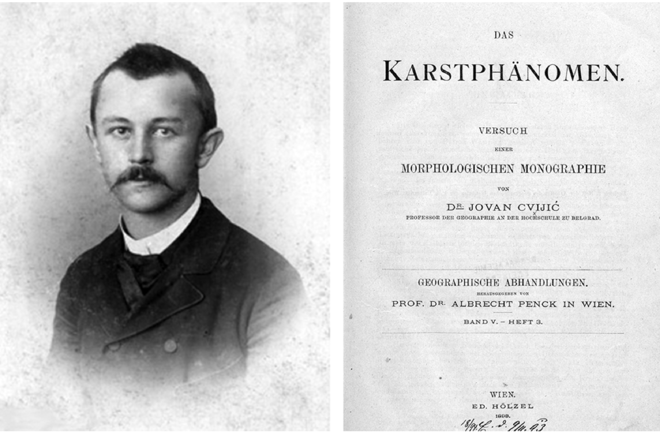
After graduating, he was appointed as a lecturer at the Second Belgrade Gymnasium. However, his intention was to continue his specialization, so he submitted a request to the Ministry of Education for a scholarship for doctoral studies in geography. He continued his further education in Vienna, where in January 1893 he received his doctorate in geography under the mentorship of Professor Albrecht Penck, one of the leading geographers of that era. His doctoral thesis on karst landforms (‘Das Karstphänomen. Versuch einer morphologischen Monographie’) laid the foundations for future research and placed him at the very top of European geography. At the beginning of March of the same year, he received copies of the scientific journal Geographische Abhandlungen in which his doctoral dissertation was published, ‘a work in which karst phenomena are comprehensively examined for the first time, their systematization is performed according to genetic criteria, and adequate terminology is created.’ The dissertation was published in Serbian in Belgrade two years later (1895) under the title Karst. A Geographical Monograph.

Teaching Career and Pioneering Work
A month after receiving his doctorate, he returned to Serbia. The Serbian Royal Regency appointed him as a full professor at the Great School in 1893. He incorporated the experience gained in Vienna during his doctoral studies into his teaching and scientific research work.
After taking office, he founded the Geographical Institute in 1894 (today’s Faculty of Geography), which became the center of scientific research work. He equipped it with globes, maps, and literature. He introduced innovations into the teaching process, established Geographical Seminars and mandatory excursions where he examined villages together with students. The same year, he also started the journal Review of Geographical (Geological, Meteorological) Literature on the Balkan Peninsula.
During the division of teaching groups at the Faculty of Philosophy, Cvijić almost entirely connected geographical sciences with natural sciences, while the Geographical Institute still remained the center of teaching and scientific work.
He was elected rector of Belgrade University twice (1906–1907 and 1919–1920). During his second term, he advocated for the reorganization of the devastated and destroyed University and helped in the establishment of five new faculties: Agriculture, Medicine, and Theology, the Faculty of Law in Subotica, and the Faculty of Philosophy in Skopje. In addition to activities in implementing teaching, Cvijić strived to secure financial resources for the successful operation of the University. He collected material resources for the establishment of the University Library and the printing of textbooks. He welcomed Cordenia Severance, a representative of the Carnegie Foundation, which allocated funds for the construction of the University Library, in Belgrade in June 1920. During his tenure as rector, he also advocated for improving the material conditions of students, and thus student cafeterias were opened on the site of former military barracks, and many buildings were converted into student dormitories.
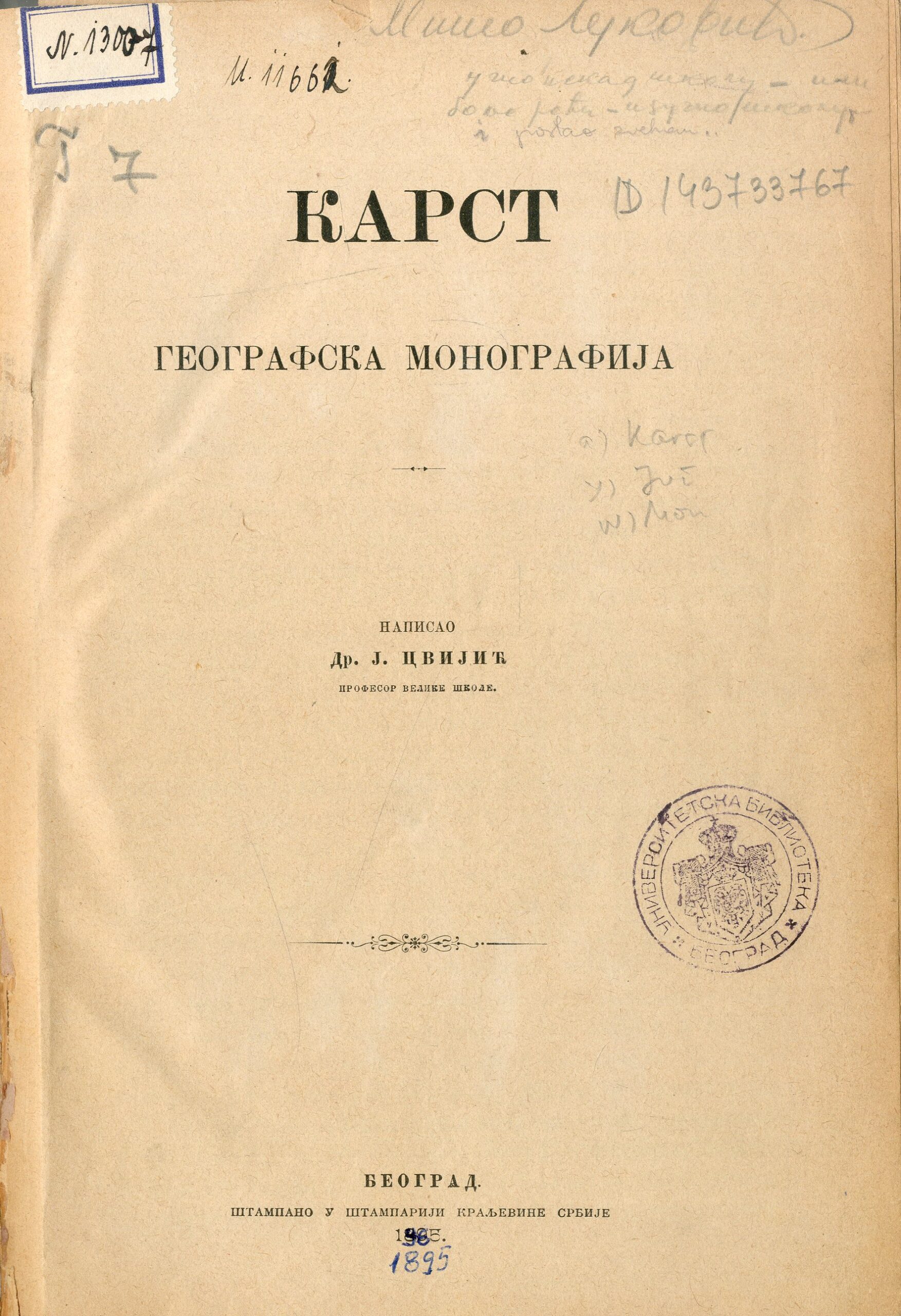
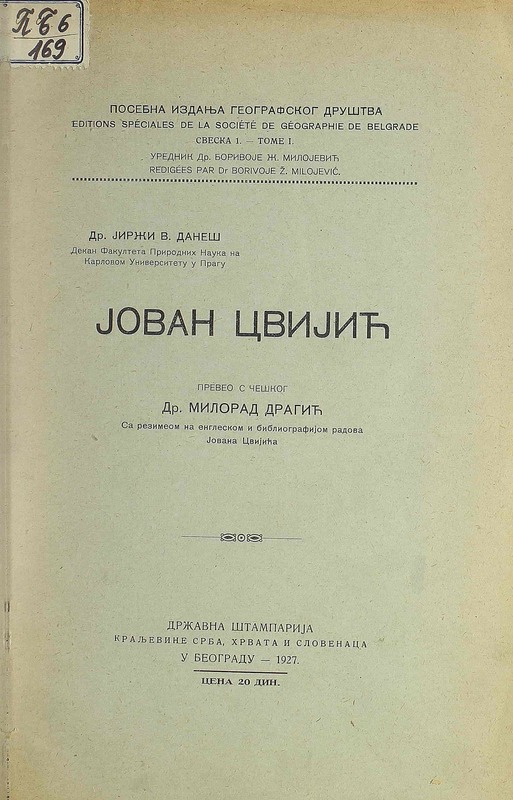
Dissertation Karst: A Geographical Monograph (1895)
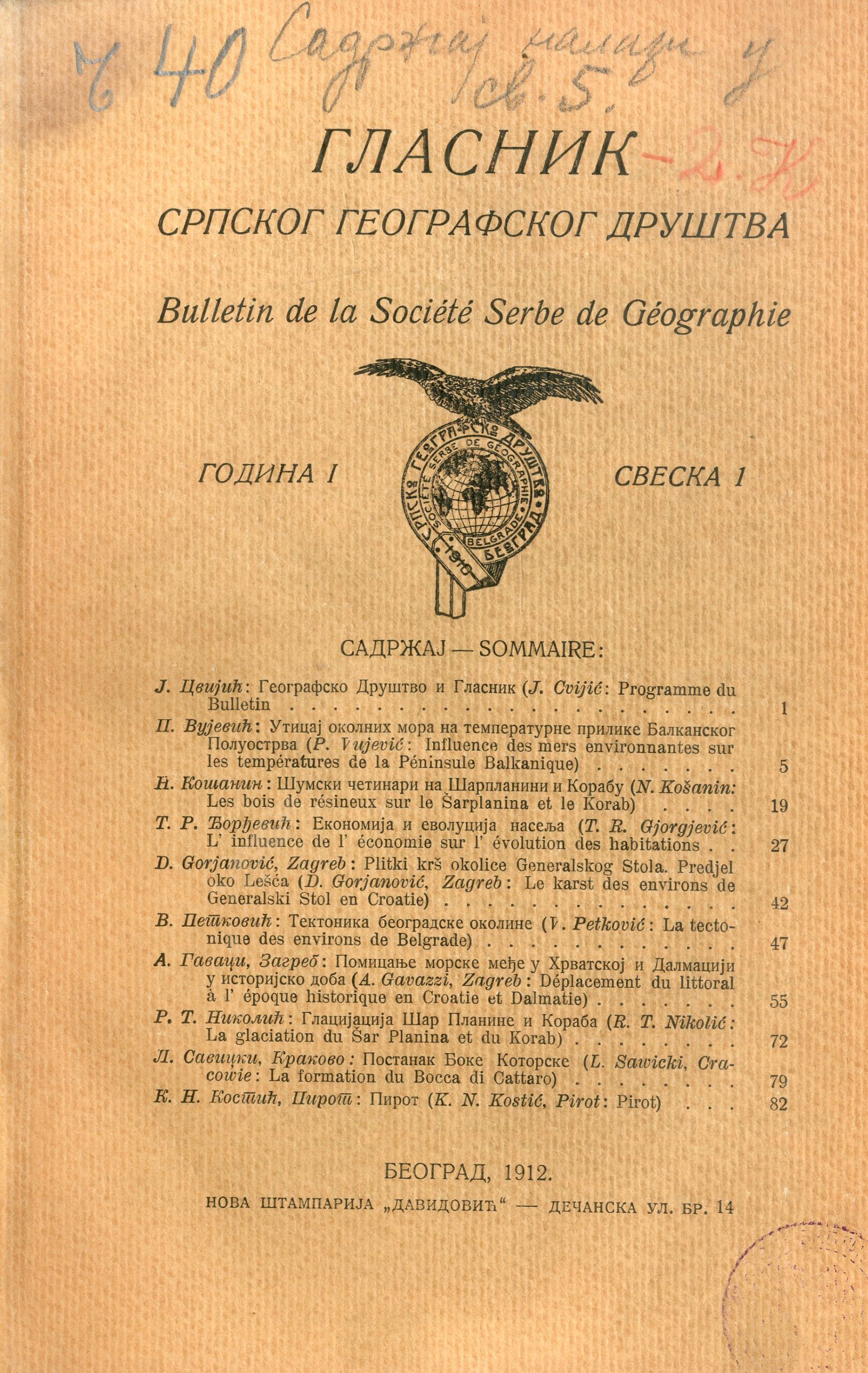
Bulletin of the Serbian Geographical Society
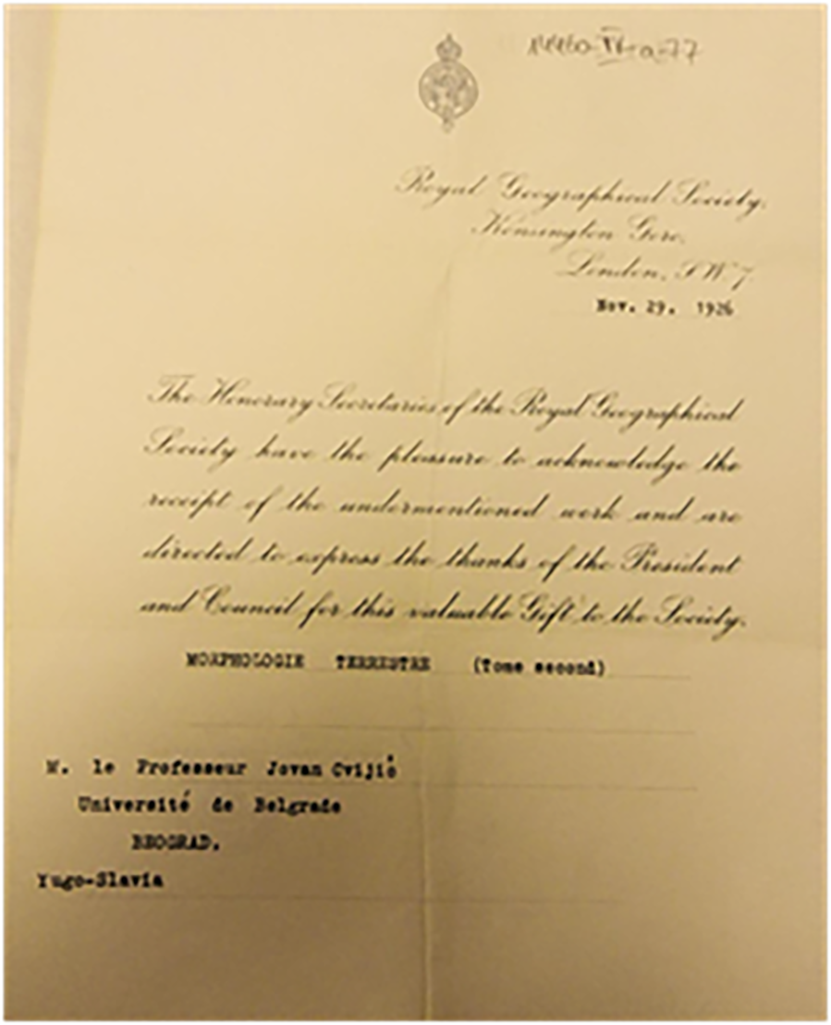
Certificate of Appreciation
of the Royal Geographical Society in London
Serbian Geographical Society
In April 1910, Jovan Cvijić and his associates founded the Serbian Geographical Society – the first organization of its kind in the Balkan Peninsula. Cvijić sent an invitation letter to all geographers and scientists in related fields to attend the founding meeting. As reasons for establishing this society, he cited the strengthened geographical center at the University, the growing number of geographical experts in Serbia and other parts of the Balkan Peninsula, increased interest in geographical and anthropogeographical research, as well as the expanding body of published geographical works relevant to economic and national questions. Numerous scientists from Serbia responded to the invitation, and at the assembly Cvijić particularly emphasized the importance of cultivating “bridge disciplines” – borderline areas between geography and related sciences, where the most valuable scientific knowledge is born.
Two years after the establishment of the Serbian Geographical Society, the first issue of the scientific journal – the Bulletin of the Serbian Geographical Society (1912) – was published, and it continues to be published to this day.
Scientific Research and Fieldwork
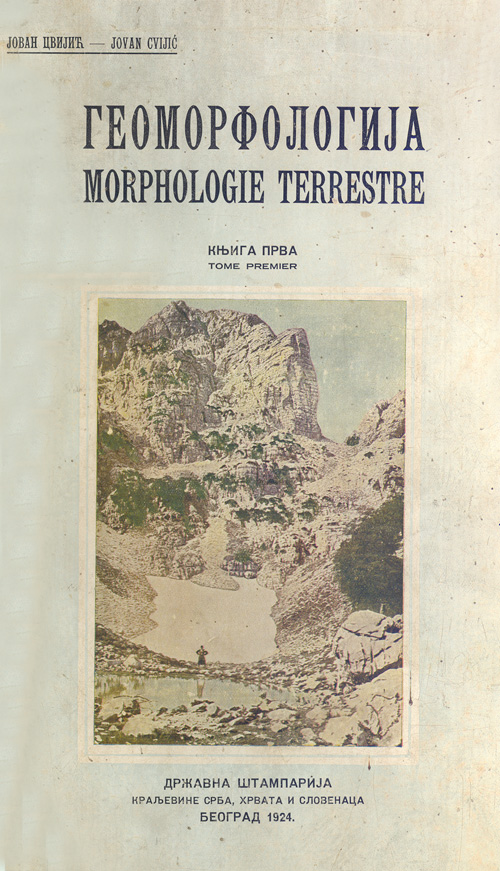
Jovan Cvijić dedicated his entire life to science and scientific research, and succeeded in building scientific geography in Serbia. He conducted field research across the Balkan Peninsula, covering an area of approximately 500,000 km², over the course of 38 years. He believed that an area could only be considered properly studied when it had been seen with one’s own eyes, traversed on foot, and thoughtfully discussed with the local population regarding important economic and social issues. As a scientist, he organized and carried out systematic field expeditions throughout the Balkans, studying the geological, geographical, and ethnographic characteristics of the region. The results of this field research on geomorphological and geotectonic phenomena were presented in his two-volume study Geomorphology (1924).
He also visited the Dachstein Alps and other parts of Austria, Germany, the French Alps and southern France, Switzerland, southern Russia and the Crimean Peninsula, the Scandinavian fjords and Norway as far as Trondheim, nearly all of Italy, Sicily with the Lipari Islands, the Southern Carpathians, and Asia Minor with the Bosphorus and Dardanelles, along with other regions of the former Ottoman Empire.
As the founder and leading expert in two completely different scientific fields: karstology (a natural science) and ethnopsychology (a social science), he greatly contributed to the understanding of geological and social phenomena. He published 47 papers on karst relief and hydrography, in which he explained the formation and development of all karst formations, as well as the complex water circulation in karst regions. He also introduced Serbian words into scientific terminology (uvala [karst valley], ponor [sinkhole], hum [hill], breg [hillside], brdo [mountain], kosa [ridge], glavica [knoll], čot [peak], čuka [summit], hrid [cliff], vrtača [doline], pećina [cave], buk [waterfall], klisura [gorge], dolina [valley], lug [grove], visoravan [plateau]…). By discovering traces of Pleistocene glaciers, he refuted the claims of prominent foreign glaciologists that there had been no glacial period in the Balkan Peninsula. Through his research on mountain systems, basins, and tectonically unstable zones, he advanced tectonic geology. He was the first among our natural scientists to systematically study lakes, thereby establishing limnology.
Anthropogeography and Ethnological Research
One of Cvijić’s most significant contributions was the introduction and development of anthropogeography – a discipline that studies the influence of the natural environment on society and culture. His anthropogeographical research focused on the relationship between humans and their geographical surroundings, migrations, mentality, and cultural patterns of Balkan peoples. Through field research, he was the first to identify the main directions of population migrations and their consequences, as well as establish a scientific classification of settlements according to position, type, and function. His views on dynamic social processes in the country, his visions of future relations among South Slavic peoples, state organization, and our capacity for creativity in science and politics were presented in the four-volume work Speeches and Articles (1921–1923).
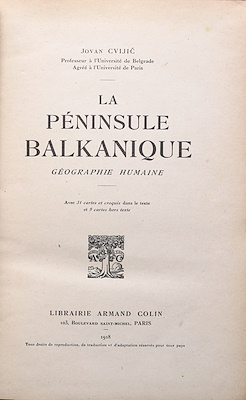
He established rigorous principles for scientific work and made scientific judgments based solely on facts, demanding the same approach from his students and colleagues. He explained his research methodology in a study on the anthropogeographical problems of the Balkan Peninsula, synthesizing his findings in the monograph The Balkan Peninsula and South Slavic Lands, which was first published in French in Paris (1918), and then in Serbian in Belgrade (1922).
Social and National Endeavors
Cvijić was not merely an academic scientist – he was highly engaged in public and political life.
During World War I, in 1916, disappointed with the Allies, he stayed in Neuchâtel, a small town in Switzerland. There he engaged in scientific work and helped Serbian refugees. At the invitation of colleagues and distinguished scientists, he was a visiting lecturer at the Sorbonne on two occasions: from 1917 to 1919, and again in 1925. The importance that France attached to the Serbian scientist’s visit is demonstrated by the fact that the French ambassador in Bern, on orders from Paris, sent one of his secretaries to escort Cvijić to the Swiss-French border.
On orders from the Serbian government, he carried out important political tasks in London, Paris, Rome, and Athens. The mission to establish diplomatic relations between England and our country, which had been severed after the May Coup of 1903, took him to London. Cvijić’s second political engagement was his participation at the Paris Peace Conference in 1919–1920 as a scientific consultant for geography and ethnography, where he represented the interests of Serbia and the Kingdom of Serbs, Croats and Slovenes, pointing out ethnographic and historical facts that were of crucial importance for determining the borders of the new state. Notably, the Peace Conference represented the first peace assembly in the history of military conflicts that, in addition to politicians, required the presence of scientists.
Testimonies of Prestige and Accomplishments

During his lifetime, Cvijić became an honorary member of many scientific and professional institutions around the world and recipient of numerous international decorations, medals, and honors.
At only 30 years old, he became a corresponding member of the Serbian Royal Academy, in the Department of Social Sciences, on the proposal of Jovan Žujović. Four years later, in 1899, he was elected as a full member of the Academy in the Department of Natural Sciences. By decree of King Peter I Karađorđević, Jovan Cvijić was appointed president of the Serbian Royal Academy in April 1921. He served as president until 1927. Also, during Cvijić’s tenure, the Academy’s palace was built at 35 Knez Mihailova Street in Belgrade, where its headquarters remain to this day.
These are just some of his numerous recognitions: corresponding member of the Royal Hungarian Geographical Society in Pest (1897), the Geographical Society in Geneva (1898), the Natural Science Society for the Study of Eastern Countries in Vienna (1898), the Belgian Geographical Society (1899), the Czech Ethnographic Society in Prague (1903), the Academy of Sciences, Letters and Arts in Italy (1903), the Geographical Society in Berlin (1908), the Czech Natural Science Society in Prague (1921); honorary member of Matica Srpska (1901), the Association of Geographers of the University of Vienna (1901), the Romanian Geographical Society in Bucharest (1903), the Royal Geographical Society in London (1906), the Natural Science Society in Neuchâtel (1916), the Czech Natural Science Society in Brno (1920), the Czech Academy of Sciences and Arts in Prague (1922), the Royal Dutch Geographical Society in Amsterdam (1923), the Geographical Society in Vienna (1926); recipient of the Order of Saint Sava Third Class (1901), the Order of Saint Sava Second Class (1904), the Order of Danilo Second Class with Star (1907), the Grand Officer’s Cross Second Degree (1910), the Commander of the Legion of Honor (1911), the Order of the White Eagle Fifth Class (1911), the Cross of Mercy for services rendered to Serbian wounded in World War I from 1914 to 1920 (1920), the Order of Saint Sava First Class (1923), the Order of the White Lion of the Czechoslovak Republic (1925); he was awarded the gold medal of the Geographical Society in Paris Prix Conrad Malte-Brun for scientific research of the Balkan Peninsula (1903), the medal Prix Eugen Patron of the Geographical Society in Paris (1917), the Gauthiot Medal (Europe) in Paris (1919), the Gold Patron’s Medal of the British King from the Royal Geographical Society in London (1920), the Gold Medal of the Geographical Society in New York (1924); full member of the Geological Society in Vienna (1908), the Sociological Society in Paris (1919), the Speleological Society in Vienna (1923); full professor at the Faculty of Philosophy of the University of Prague (1903); honorary president of the Fifth Congress of Czech Natural Scientists and Physicians (1914), the First Congress of Slavic Geographers and Ethnographers in Prague (1924), the Yugoslav-Czechoslovak League in Belgrade (1925); honorary doctorate from Charles University (1922), the University of Paris (1924), etc.
Final Years and Legacy
Jovan Cvijić spent much of his life conducting fieldwork on lengthy and demanding research expeditions, often in difficult and unfavorable conditions. This way of life took its toll on his health, and the first serious symptoms of illness appeared before he turned 47.
One of the most distinguished Serbian intellectuals, who was received with great respect even outside Serbia, passed away at dawn on January 16, 1927, in Belgrade. His wife Ljubica received over 600 telegrams of condolence from around the world—proof of the deep respect he enjoyed in academic and social circles throughout the country and Europe. Among the many who paid their respects to Cvijić were King Aleksandar, Professor Milutin Milanković, and the then-rector Pavle Popović.

In 1963, the Institute for the Protection of Cultural Monuments of the City of Belgrade issued a decree establishing the memorial status of Jovan Cvijić’s house, thereby placing both the personal legacy of the distinguished geographer and scientist, as well as the building itself, under protection. During the commemoration of the centenary of the scientist’s birth in 1965, a decision was made to establish a Memorial Museum, which opened to visitors in 1968.
Jovan Cvijić’s contribution to science and education remains indelible. His life’s path, dedicated to research, the transmission of knowledge, and service to society, stands as the finest example of the power of individual dedication in building scientific and national consciousness. He himself said: “The more you give of yourself, the more will return to you.” And that is how he lived—with perseverance, hard work, and faith in the value of knowledge.

References
Click for more
Stevan M. Stanković, Jovan Cvijić: darovita i osećajna duša, Beograd: Srpsko geografsko društvo, 2006.
Tatjana Korićanac, Beogradski atlas Jovana Cvijića: vek i po od rođenja: 1865–2015, Beograd: SANU, Muzej grada Beograda, 2015.
Stevan M. Stanković, Jovan Cvijić 1927, Beograd: Geografski fakultet, 2019.
Ljubinka Trgovčević, Naučnici Srbije i stvaranje Jugoslavije: 1914–1920, Prometej; Radio-televizija Srbije, 2020.
Jovan Cvijić: život, delo, vreme: povodom 150 godina od rođenja, Beograd: SANU; Geografski institut „Jovan Cvijić“, 2021.
Selected Bibliography
Click for more
Današnje stanje geografske nauke : uvodno predavanje iz geografije Jovana Cvijića. – Beograd : Državna štamparija Kraljevine Srbije, 1893. – 34 str. ; 24 cm
PB15 505
Prilozi za poznavanje Jadranskog Primorja : (promatranja i studije) / od J.[Jovan] Cvijića. – [Beograd : b. i.], 1894. – 9 str. ; 32 cm
P. o.: Prosvetni glasnik ; 1894.
BG 150
Karst : geografska monografija / napisao J. Cvijić. – Beograd : [b. i.], 1895. – IX, 173 str. : ilustr. ; 23 cm
G 7
Pećine i podzemna hidrografija u Istočnoj Srbiji / od Jovana Cvijića. – U Beogradu : Štamparija Kraljevine Srbije, 1895. – 101 str., [9] listova s tablama (od toga 2 presavijena) : ilustr. ; 24 cm. – (Glas / Srpska kraljevska akademija ; 46. [Razred 1, Prirodno-matematičke nauke] ; [knj. 16])
PČ I 3/46
Pregled geografske literature o Balkanskom poluostrvu / uredio J. Cvijić. – Beograd : Državna štamparija Kraljevine Srbije, 1895–1908. – 4. knj. ; 32 cm
Ib 102 / 1–4
Izvori, tresave i vodopadi u Istočnoj Srbiji / od J. Cvijića. – [Beograd : Državna štamparija Kraljevine Srbije, 1896]. – 122 str., [5] listova s tablama, [5] presavijenih listova ; 25 cm
P. o.: Glas Srpske kraljevske akademije ; 51.
PB15 347
Tragovi starih glečera na Rili / od J. Cvijića. – Beograd : Srpska akademija nauka, 1896. – 105 str., [3] presav. lista, [3] lista s tablama : ilustr., geog. karte ; 24 cm
P. o.: Glas Srpske kraljevske akademije ; 54. Razred 2 ; 19)
G 193
Uputstva za proučavanje sela u Srbiji i ostalim srpskim zemljama / [J. Cvijić]. – Beograd : Srpska Kraljevska Državna štamparija, 1896. – 24 str. ; 15 cm
BG 513
Das Rila-Gebirge und seine ehemalige Vergletscherung / von J. Cvijić. – [Berlin : s. n.], 1898. – Str. 201-253, [2] savijena lista : geografske karte ; 23 cm
P. o.: Zeitschrift der Gesellsch für Erdkunde zu Berlin ; Bd. 33.
R 393
Glacijalne i morfološke studije o planinama Bosne, Hercegovine i Crne Gore / od dr J. Cvijića. – Beograd : Srpska kraljevska akademija, 1899. – 196 str. ; 23 cm. – (Glas / Srpska kraljevska akademija ; 57. Razred 1 ; 21)
PČ I/3
Opšta Geografija : antropogeografija / [Jovan Cvijić]. – Beograd : Leon D. Alcalay, 1901. – 224 str. ; 34 cm
Ša 945
Antropogeografski problemi Balkanskoga poluostrva / od J. Cvijića. – [Beograd : Izdanje Srpske akademije nauka, 1902]. – [1], CCXXXVI, [1] str. : ilustr. ; 24 cm
P. o.: Etnografski zbornik ; knj. 4.
G 153/
Geološki atlas Makedonije i Stare Srbije [Kartografska građa] / od J. Cvijića. – Beograd : Akademija nauka, 1903. – 1 atlas (8 listova s geogr. kartama) : u boji ; 68 cm
23/ 1
Balkanska, alpijska i karpatska glacijacija / od dr J. Cvijića. – Beograd : Srpska kraljevska akademija, 1904. – Str. 175–207 ; 23 cm. – (Glas / Srpska kraljevska akademije ; 67. Razred 1 ; 26)
PČ I/3
Uputstva za proučavanje sela u Bosni i Hercegovini / J. Cvijić. – U Srem. Karlovcima : Srpska manastirska štamparija, 1904. – 14 str. ; 24cm
P. o.: Kalendar „Prosveta“ ; 1905.
PB10 3077
Osnove za geografiju i geologiju Makedonije i Stare Srbije : s posmatranjima u Južnoj Bugarskoj, Trakiji, susednim delovima Male Azije, Tesaliji, Epiru i Severnoj Arbaniji. Knj. 1 : (Sa 51 geogr. i geol. skicom, profilima i fotografijama) / napisao J. Cvijić. – Beograd : [b. i.], 1906. – VIII, 392 str. : ilustr. ; 32 cm + dod. – (Posebna izdanja / Srpska kraljevska akademija ; knj. 17. Prirodnjački i matematički spisi ; knj. 3)
III 6059/1
Osnove za geografiju i geologiju Makedonije i Stare Srbije : s posmatranjima u Južnoj Bugarskoj, Trakiji, susednim delovima Male Azije, Tesaliji, Epiru i Severnoj Arbaniji. Knj. 2 : (Sa 83 geogr. i geol. skice, profila i fotografije u tekstu i 19 ilustr. fotografija u prilogu) / napisao J. Cvijić. – Beograd : [b. i.], 1906. – Str. [1-4], 393-688, [1], [20] listova s tablama, [3] presavijena lista : ilustr. ; 32 cm + dod. – (Posebna izdanja / Srpska kraljevska akademija ; knj. 18. Prirodnjački i matematički spisi ; knj. 4)
III 6059/2
Promatranja o etnografiji makedonskih Slovena / napisao J. Cvijić. – 2. popunjeno izd. – Beograd : G. Kon, 1906. – 69 str. ; 24 cm + statističke tablice maked. naroda
G 344
O naučnom radu i o našem univerzitetu : (Svetosavski govor 1907.) / Jovan Cvijić. – Beograd : Državna štamparija Kraljevine Srbije, 1907. – 63 str. ; 24 cm
Šs 2
Aneksija Bosne i Hercegovine i srpski problem : (sa dve karte) / Jovan Cvijić. – [Beograd : Knjižara S. B. Cvijanovića], 1908. – 62 str. : ilustr. ; 24 cm
I 88
KARTA Stare Srbije i Makedonije [Kartografska građa] / (po Stielerovu Atlasu i podacima J. Cvijića). – 1:1 500 000. – Gotha : Justus Perthes ; Beograd : Knjižarnica S. B. Cvijanovića, 1908. – 1 geogr. karta : u boji ; 46 x 39 cm, presavijena na 20 x 12 cm
24/ 23
Antropogeografski pregled Epira / J. Cvijić // Nova iskra. – God. 10, br. 1 (1911), str. 9-12.
Č 1177
Karta Srbije i Crne Gore [Kartografska građa] / od J. Cvijića. – 3. pregledno i popravljeno izd. – Razmer 1:750 000. – Beograd : Knjižarnica Gece Kona, 1911. – 1 geog. karta : u boji ; 52 x 53,5 cm, presavijena na 18 x 17 cm
PB11 1749
Osnove za geografiju i geologiju Makedonije i Stare Srbije : s promatranjima u južnoj Bugarskoj, Trakiji, susednim delovima Male Azije, u Tesaiji i Epiru : (sa 24 geografske i geološke karte i fotografije izvan teksta i sa 71 profilom i skicom u tekstu). Knj. 3 / J. Cvijić. – Beograd : Srpska kraljevska akademija, 1911. – VIII str., str. 689-1272, [9] presavijenih listova s geogr. kartama, [14] listova s tablama : ilustr. ; 33 cm
III 6059/3
Uputstva za ispitivanje naselja i psihičkih osobina / [J. Cvijić]. – Beograd : Nova štamparija „Davidović“, 1911. – 49 str. ; 24 cm
G 442
Balkanski rat i Srbija / Jovan Cvijić. – 2. izd. – Beograd : Nova štamparija „Davidović“, 1912. – 16 str. ; 24 cm
P. o.: Srpski književni glasnik ; knj. 29, br. 9.
I 1032/1
Ledeno doba u Prokletijama i okolnim planinama / [napisao] J. Cvijić. – Beograd : Srpska kraljevska akademija, 1913. – Str. 188–267 : ilustr. + 2 karte ; 23 cm. – (Glas / Srpska kraljevska akademija ; 91. Razred 1, 38)
PČ I / 3
Geografski i kulturni položaj Srbije / Jovan Cvijić. – Sarajevo : Izdanje I. Đ. Đurđevića, 1914– 31 str. ; 20 cm
P. o.: „Ratna Spomenica“ Bosanske Vile.
PB5 2263
Jedinstvo Jugoslovena : prva polovina : (sa 1 kartom) / od Dinaricus-a. – Niš : Državna štamparija Kraljevine Srbije, 1915. – 60 str. : ilustr. ; 33 cm
R 3158
Questions Balkaniques. 1 , Une publication anglaise sur les problèmes balkaniques. Les assertions d›un écrivain bulgare. Les bases géographiques de la question macédonienne. Remarques sur l›ethnographie de la Macédoine / Jovan Cvijić. – Paris ; Neuchatel : Attinger frères, [1916]. – 79 str. ; 22 cm
PB6 46
La Péninsule balkanique : géographie humaine : avec 31 cartes et croquis dans le texte et 9 cartes hors texte / Jovan Cvijić. – Paris : Librairie Armand Colin, 1918. – VIII, 528, [4] str., [9] presavijenih listova s geogr. kartama : ilustr. ; 25 cm
PB21 2708
Abrazione i fluvijalne površi : sa 60 skica i profila u tekstu i 11 fotografija u prilogu : (prvi članak) / Jovan Cvijić. – Beograd : Državna štamparija Kraljevine Srba, Hrvata i Slovenaca, 1921. – 61 str. : skice, fotogr. ; 29 cm
P. o.: Glasnik geografskog društva; god. 5, sv. 11, 1921.
G 97
Govori i članci / Jovan Cvijić. – Beograd : Izdavačka knjižarnica „Napredak“, 1921-1923. – 4 knj. ; 25 cm
G 6/1-4
Balkansko Poluostrvo i južnoslovenske zemlje : osnove antropogeografije : sa 49 karata i skica u tekstu i sa 7 karata i 54 fotografije izvan teksta. Knj. 1 / Jovan Cvijić ; preveo s francuskog Borivoje Drobnjaković. – Beograd : Državna štamparija Kraljevine Srba, Hrvata i Slovenaca, 1922. – XVI, 418 str., [6] presavijenih listova : ilustr. ; 25 cm
G 26/1
Seobe i etnički procesi u našem narodu : jedno predavanje : s kartom / Jovan Cvijić. – Sarajevo : Društvo Prosveta, 1922. – 20 str. ; 21 cm. – (Prosvetina biblioteka ; sv. 8)
Ј 94/8
Geomorfologija = Morphologie terrestre : sa 94 fotografije i 12 karata izvan teksta, 420 skica, fotografija i 87 karata u tekstu. Knj. 1 = Tome 1 / Jovan Cvijić. – Beograd : Državna štamparija Kraljevine Srba, Hrvata i Slovenaca, 1924. – XXI, 588 str., [60] listova s tablama, [1] presav. list sa geogr. kartama : ilustr. ; 29 cm
G 31/1
Geomorfologija = Morphologie terrestre : sa 156 fotografija i 5 karata izvan teksta, 436 skica, fotografija i karata u tekstu. Knj. 2. Tome 2 / Jovan Cvijić. – Beograd : Državna štamparija Kraljevine Srba, Hrvata i Slovenaca, 1926. – 506 str., [95] listova s tablama, [5] presavijenih listova sa geogr. kartama : ilustr. ; 29 cm
G 31/2
Editorial Work
Jovan Cvijić edited over 20 books on the Settlements of Serbian lands as part of the Serbian Ethnographic Collection and the “Settlements and Origin of the Population” series. The first book of this major undertaking, which comprises 47 publications in total, was published in 1902, and the last one Cvijić edited came out in 1926, a year before his death.
Click for more
NASELjA srpskih zemalja : rasprave i građa. Knj. 1 / uredio J. Cvijić. – U Beogradu : Srpska kraljevska akademija, 1902. – CCXXXVI, 497 str. : ilustr. ; 24 cm. – (Srpski etnografski zbornik / Srpska kraljevska akademija ; knj. 4. [Odeljenje 1, Naselja i poreklo stanovništva ; knj. 1])
R 3042
NASELjA srpskih zemalja : atlas. Knj. 1 / uredio J. Cvijić [kartografska građa]. – [1:1.500.000]. – Beograd : Srpska kraljevska akademija, 1902. – XXIII table : geog. karte (jedna u boji) i crno bele fotografije ; 33 cm. – (Srpski etnografski zbornik / Srpska Kraljevska akademija ; knj. 4)
PČ II 10/4/Atlas
NASELjA i poreklo stanovništva. Knj. 23 / uredio Jovan Cvijić. – Beograd : Srpska kraljevska akademija, 1926. – VIII, 599 str., 6 fotografija, 7 skica, 2 karte : ilustr. ; 24 cm. – (Srpski etnografski zbornik / Srpska kraljevska akademija ; Knj. 38)
PČ II 10/38