Jovan Žujović
(1856–1936)
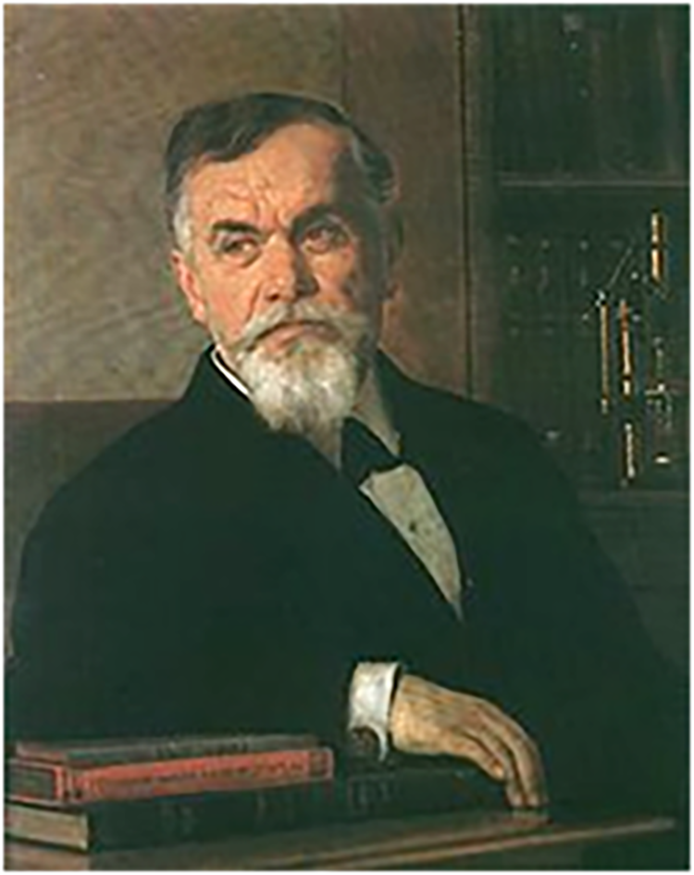
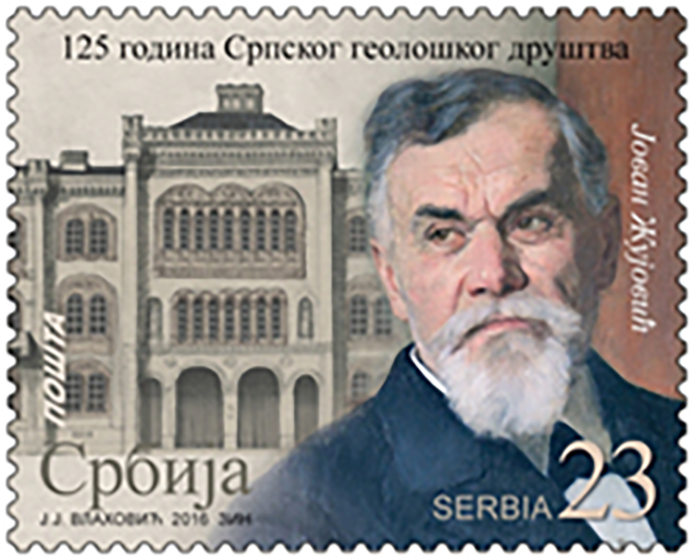
Serbian geologist, academician, rector of the Grand School and professor, founder of Serbian geological science, senator, state councilor, member of parliament, minister of education and foreign affairs. His research laid the foundations of geology and stratigraphy in Serbia, and he significantly contributed to the development of paleontology and anthropology. Through his reputation, education, intelligence, great effort and talent, he became part of a narrow circle of intellectuals who marked Serbian science and culture in the last decades of the 19th and first decades of the 20th century. And thanks to Žujović, Serbia was counted among the small number of countries in Europe that were geologically studied in the 19th century.
Childhood and Education
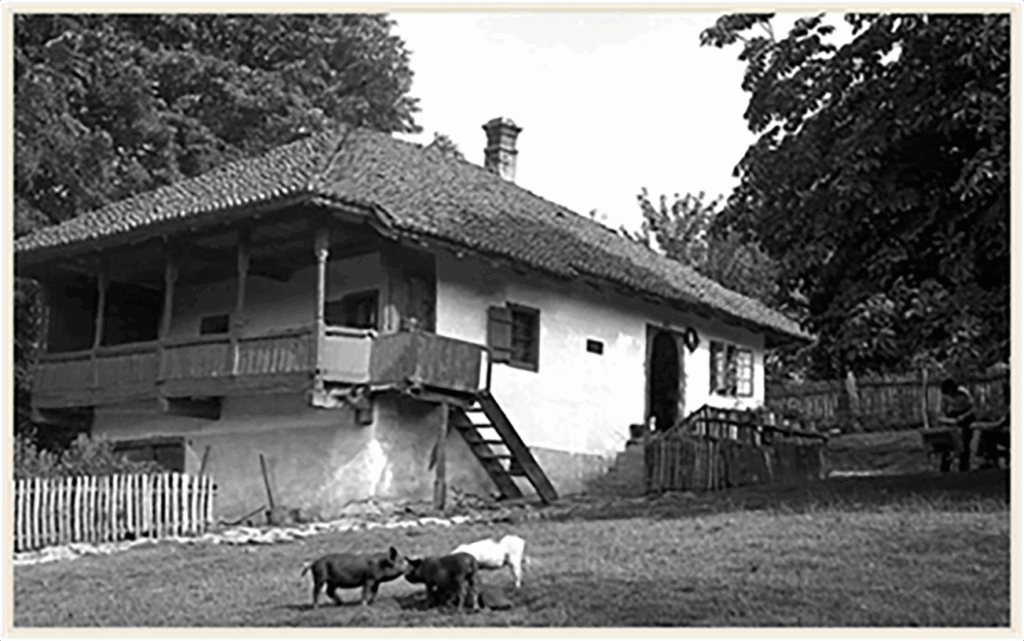
He was born on October 31, 1856, in Brusnica, near Gornji Milanovac, where his father Mladen, a great lover of literature and head of the Rudnik District, served, while his mother Jelena, daughter of an insurgent prince, managed the household. He began elementary school in the place of Nemenikuće near Sopot where they had a large estate, and then moved with his family to Belgrade, where he completed elementary school and the upper grades of the Science-oriented Secondary School. He studied the socialist ideas of Svetozar Marković and under that influence wanted to enroll in the Polytechnic in Zurich. After an unsuccessful first year, he returned to Belgrade and in 1873 enrolled in the Natural Sciences and Mathematics Department of the Faculty of Philosophy at the Grand School. In his early youth he mastered Russian, French and German. He showed an affinity for natural sciences, but was equally attracted to politics. Professor Josif Pančić ignited Žujović’s love for natural sciences and charted his scientific path, which led him in 1876 to Paris, to the Sorbonne. In July 1879 he graduated with notable success. Žujović decided to dedicate himself to geology, so he remained in Paris to work in the petrographic laboratory at the Collège de France. He studied a large collection of igneous and metamorphic rocks from the Andes, about which he published his first scientific paper in 1880, gaining international recognition.
Pedagogical, Scientific, and Social Engagement Achievements
Upon returning to Serbia in 1880, he became the first professor of geology and mineralogy at the Great School. In his “boots,” these sciences advanced by leaps and bounds. He expected his students to be well-informed natural scientists familiar with research methods and systematized facts. He traveled throughout Serbia and began its geological study. He created collections of minerals, rocks, and fossils, conducted practical exercises and field research, established libraries, and wrote and translated textbooks. From Paris he brought the first polarizing microscope to Serbia and applied it to the examination of local rocks, only about twenty years after microscopes had begun to be used in this field worldwide. He produced the first Geological Map of Serbia (1882, 1886, 1889). By the end of the decade, he had written geology textbooks in which he interpreted the existing knowledge of endodynamics and exodynamics, and he published papers in foreign journals. He was also Serbia’s first learned archaeologist, collecting and scientifically describing archaeological material.
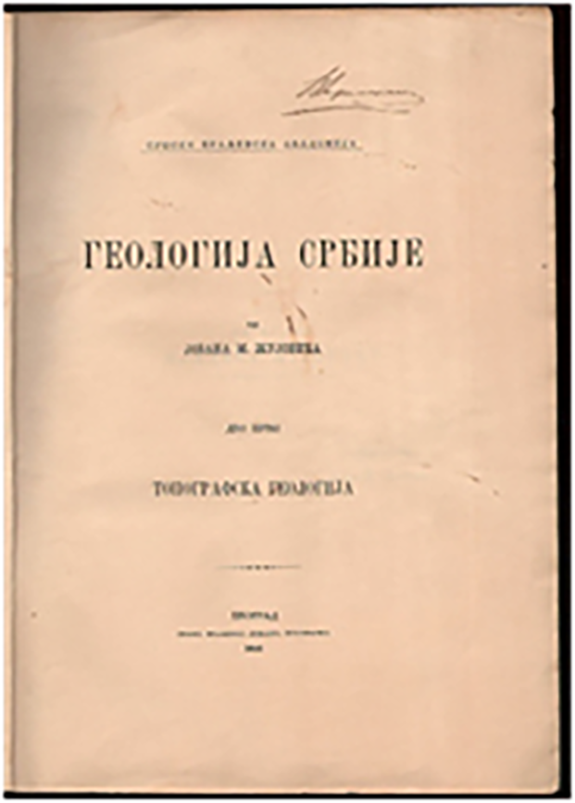
Gifted and strong-willed, he founded the Mineralogical and Geological Institute in 1883, and that same year participated in establishing the Serbian Archaeological Society. He founded the Geological Institute in 1889. He was the founder and editor of the journal Geological Annals of the Balkan Peninsula (1889). He began the last decade of the 19th century by establishing the Serbian Geological Society (1891), which emerged spontaneously from student conferences. Until 1952, its headquarters were located in the Captain Miša Building and brought together Serbia’s intellectual elite from various professions, whose contributions were published in the Records (a journal that has been published from 1897 to the present day). He published his magnum opus and crowning achievement, the first volume of the monograph Geology of Serbia (1893), compiled from materials he personally collected, which placed our country in the small circle of European nations that had been geologically surveyed by the end of the 19th century. He left behind 168 papers, about twenty original and translated books, and 138 reviews and reports.
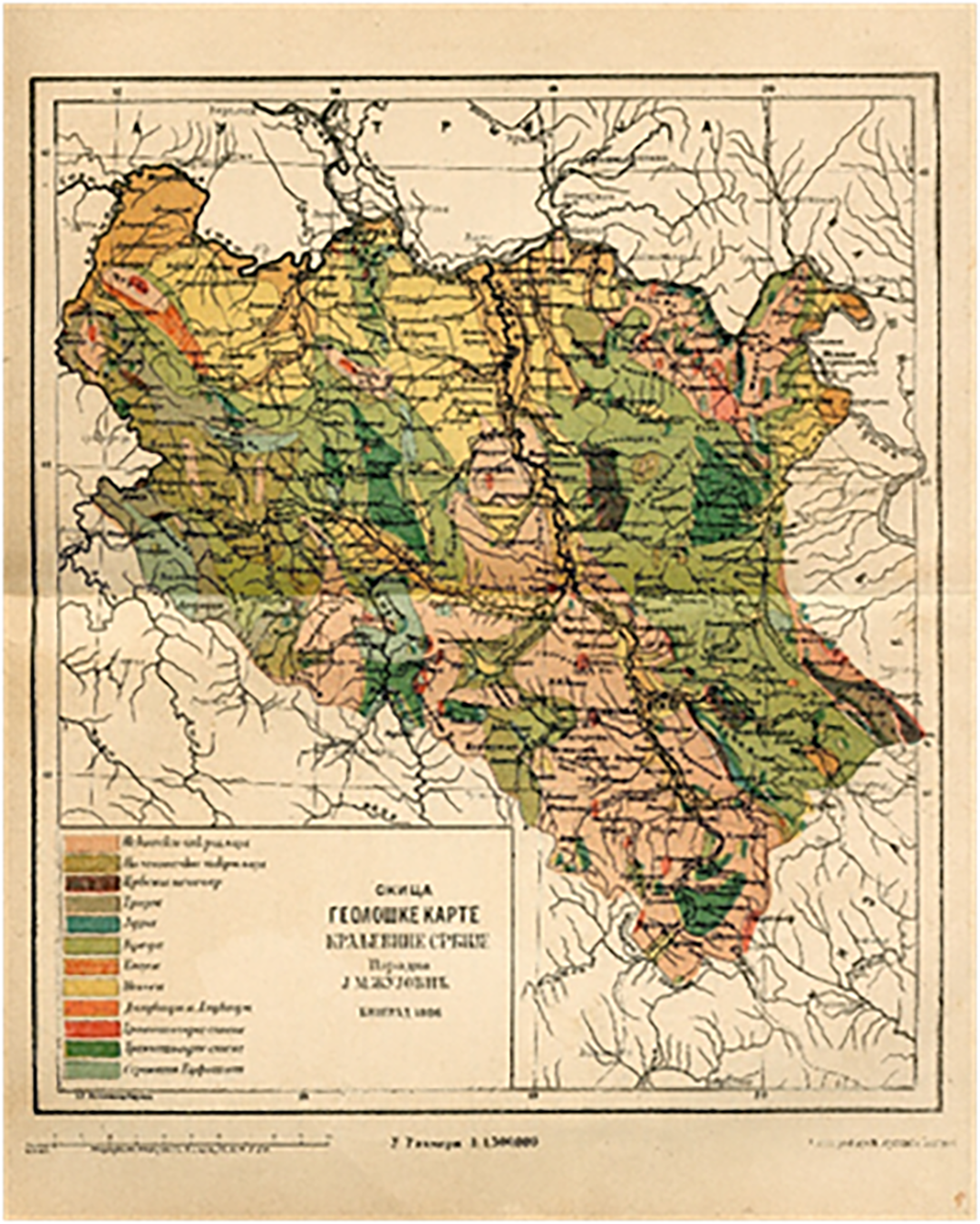
Geological Map of Serbia
(1886)
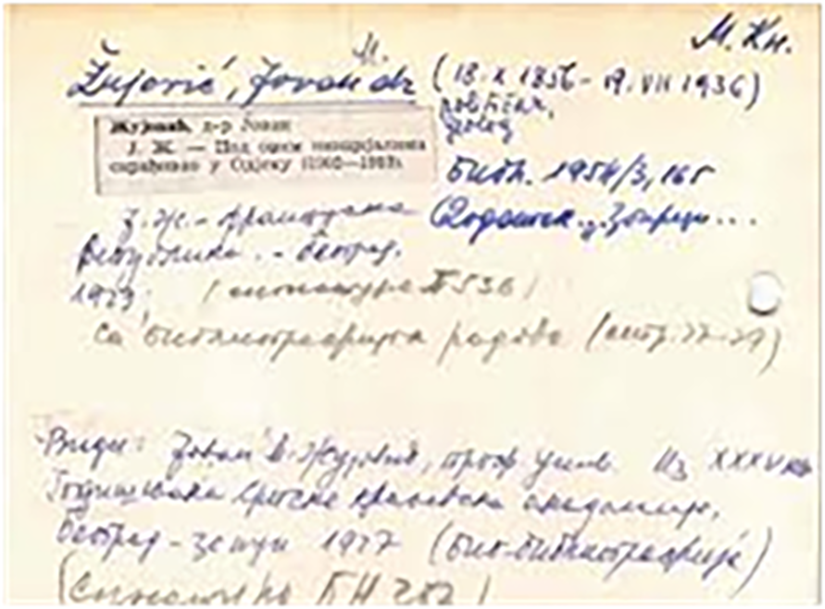
Catalog card from the database
of Serbian pseudonyms at the University Library
He served as secretary of the Serbian Royal Academy. He also participated in launching work on the compilation of the Yugoslav Encyclopedic Dictionary. As a nature lover, he established the Serbian Mountaineering Society (1901), serving as its president for many years. He also made a significant contribution to the opening of the Natural History Museum in Belgrade (1904). He devoted great effort to establishing the French Literary Society, which brought together Serbian intellectuals and politicians educated in France.
He advocated for the establishment of cooperatives and agricultural schools. Before the war, he published ‘Work Program for the Good of the Village’ (1914). Thanks to his efforts, a sum was allocated in the State Loan Act of 1905 for the establishment of an Agricultural Department at the newly founded University, which after the war was used to purchase all the equipment for the Faculty of Agriculture and Forestry in Belgrade. He was a long-time member of the Main Union of Agricultural Cooperatives, and from 1919 served as the first vice president of the Yugoslav Agricultural Cooperatives.
He was elected rector of the Grand School in 1896. In this capacity, he implemented organizational changes that enabled it to transition very smoothly into a University.
After the failed the Nativity of John the Baptist assassination attempt on King Milan, Žujović was suddenly pensioned off and exiled from Serbia on July 21, 1899, most likely for political reasons on the orders of King Milan, who used the assassination attempt as a pretext to crack down on socialism at the Grand School. He went to Paris to the laboratory where he had previously worked, and there completed the second volume of his monograph Geology of Serbia, which contains account of the igneous rocks from Serbia known at that time. He was granted amnesty in mid-1900.

On the Political Stage
Upon returning to Serbia, he became involved in political life. He served as senator, state councilor, member of parliament, and minister of education and foreign affairs (1905 and 1910). During his second term, he resigned due to the meager funds allocated for education. As a member of parliament, he actively participated in drafting the University Act. When that law came into effect in 1905, he was appointed as one of the first eight full professors at the new University. During World War I, he saved the library of the Geological Institute and the meteorite collection from the Natural History Museum. As an unofficial representative of the Serbian government, he went to Paris in 1915 to defend the future borders of the state against territorial claims by Italy, Bulgaria, and Romania. Additionally, he tirelessly reported on Serbia’s suffering in the Great War, and as a convinced Francophile, worked to create the strongest possible allied and fraternal ties between the two nations. At the government’s request, he traveled from Paris to London in 1915 to ease tensions between Serbian delegates and the Yugoslav Committee, particularly with the intrigue-prone Frano Supilo. In late 1915 and early 1916, as a member of the French university committee and head of the Serbian School Office, he gathered 4,000 students and pupils who had fled from Serbia and placed them in schools and universities throughout France. After the war, together with Ljubomir Stojanović and Jaša Prodanović, he founded the Republican Party and criticized the monarchy as a reflection of society’s spiritual and moral decline. He believed that only youth could bring about moral recovery because they ‘know that to live does not mean merely to exist from birth to death (…), but also to work for the common good, to illuminate what is dark in the present, to inspire the dawn of the future (…) and to reverently remember the brilliant figures from the past.’ After 1931, he completely withdrew from public life; he only continued to teach at the University and attend meetings of the Serbian Geological Society.
Honors
Jovan Žujović received recognition for his persistent, diligent, and expert work during his lifetime. His first recognition was his election to the Serbian Learned Society (1883). This was followed by elections to the Yugoslav Academy of Sciences and Arts (1886), the Hungarian Geological Society (1886), and the Kiev Society of Naturalists (1887). He was a member of the Serbian Royal Academy from 1887 and served as its president from 1915 to 1921. He was awarded the Order of St. Sava, 3rd Class (1893), the French Order Officier de l’Academie (1898), the Medal Commemorating the Fortieth Anniversary of the Great St. Andrew’s Assembly (1899), the French Order Grand Officier de l’ordre national de la Legion d’honneur (1911), the Cross of Mercy (1914), and the Bulgarian Order for Civil Virtues. He particularly treasured the recognition from colleagues and students who, on the thirtieth anniversary of the Serbian Geological Society, gave him a geological hammer whose handle still bears readable signatures today and is preserved in the ceremonial room of the Institute of Geology and Paleontology at the University of Belgrade. He was elected lifetime honorary president of the Serbian Geological Society. As a mark of exceptional respect, paleontologists named fossils after Žujović.
The Passing of the Serbian Geologist
At the beginning of 1933, Žujović wrote: ‘This year will bring me nothing new. If there is anything new, it will be a worsening of the current state. I am less and less satisfied with myself and realize that there is no cure for my malady. It is not sclerosis or other physical ailments—sadness holds me constantly and ever more strongly.’ He died in advanced age, completely alone, in July 1936 in Belgrade, leaving behind an exceptionally rich scientific and social legacy. All the capital’s newspapers reported his death, and Politika published an extensive biography of Jovan Žujović—a man about whom academician Aleksandar Belić wrote that ‘upon him could be founded the entire culture of a nation.’ In the memory culture of the people to whom he belonged, the recollection of this giant’s work—a man of broad education, scientific renown, and European manners—is fainter than he deserves. A bust in the courtyard of the church in Nemenikuće, cast by sculptor Đorđe Jovanović, is the only public monument erected to him, and his name graces only two streets (in Belgrade and Sopot) and a technical secondary school in Gornji Milanovac.

References
Click for more
Aleksandar Grubić, „Jovan M. Žujović“, Život i delo srpskih naučnika, Beograd: Srpska akademija nauka i umetnosti, 1996, 291–360.
Vidojko Jović, Jovan Žujović kao geolog i arheolog, Beograd: Centar za naučna istraživanja SANU i Univerziteta, 2006, str. 143–167.
Đorđe Đurić, Srpski intelektualac u politici: politička biografija Jovana Žujovića, Beograd: Službeni glasnik, 2014.
Vladimir Milanović, Velikani prirodnih nauka (12 plakata), Beograd: Službeni glasnik, 2024.
Selected Bibliography
Click for more
Note sur les roches éruptives et metamorphiques des Andes / J. Jouyovitch. – Belgrade : [s.n.], 1880. – 19 str. ; 24 cm
PB15 1810
Pristupno predavanje Jovana Žujovića, suplenta Velike škole držano 16. decembra 1880. – Beograd : Državna štamparija, 1881. – 22 str. ; 21 cm
Šs 6
Kratki pregled istorije mineralogije / Jovan M. Žujović. – Beograd : U Kraljevsko-srpskoj državnoj štampariji, 1883. – 71 str. ;21cm
N 73
Sur les roches éruptives de la Serbie / Jovan M. Žujović. – Paris : [s.n.], 1883.
BN3 100
Sur les terrains sédimentaires de la Serbie / Jovan M. Žujović. – Paris : [s.n.], 1883.
BN3 28
Građa za geologiju Kraljevine Srbije / od J. M. Žujovića – U Beogradu: Kraljevska srpska državna štamparija, 1884–1885. – 4 knj. ; 25cm
N 75 /1-4
Nove petrografske fele / od J. M. Žujovića. – U Beogradu : Kraljevsko-srpska državna štamparija, 1885. – 14 str. ; 25 cm
BN 29
Bibliografija za geologiju Balkanskog poluostrva = Bibliographie geologique dela presqu’île des Balkans. 1, 1886 / od J. M. Žujovića. – Beograd : Kraljevska srpska državna štamparija, 1888. – 12 str. ; 32 cm
PB15 502
Geologische Übersicht des Königreiches Serbien / Jovan M. Žujović. – Wien : Hölder, 1886. – 54str.
BN4 11
Скица геолошке карте Краљевине Србије [Картографска грађа] / израдио Ј. М. Жујовић. – [1:1,500.000]. – Београд : Литографија М. Јорговића, 1886. – 1 геог. карта : у боји ; 29 x 23 cm
Skica geološke karte Kraljevine Srbije [Kartografska građa] / izradio J. M. Žujović. – [1:1,500.000]. – Beograd : Litografija M. Jorgovića, 1886. – 1 geog. karta : u boji ; 29 x 23 cm
24/106
Petrografska mineralogija / napisao Jovan M. Žujović. – Beograd : Kraljevsko-srpska državna štamparija, 1887. – XVIII, 94 str. ; 22cm
N 14
Lamprofiri u Srbiji : saopšteno Akademiji prirodnih nauka 14. oktobra 1887 god. / od Jovana M. Žujovića. – Beograd : Kraljevsko-srpska državna štamparija, 1888. – 31 str. ; 24 cm. – (Glas / Srpska kraljevska akademija ; 3)
PČ I 3/3
Osnovi za geologiju Kraljevine Srbije : sa skicom geološke karte / sastavio J. M. Žujović. – 2. izd. – Beograd : Srpska kraljevska državna štamparija, 1888. – IV, 130 str. ; 23 cm
P.o.: Geološki anali Balkanskog poluostrva ; knj. 1.
N 29
Petrografija / napisao Jovan M. Žujović. – Beograd : Državna štamparija, 1889-1895. – 2 knj. ; 23 cm
N 28
Geološki anali Balkanskoga poluostrva = Annales géologiques de la Péninsule Balkanique. Knj. 2. Deo 2 / uređuje J. M. Žujović. – Beograd : Kraljevsko-srpska državna štamparija, 1890. – 32 str., [3] lista s tablama : ilustr. ; 24 cm
PB15 509
Eufotiti u Srbiji / od J.M. Žujovića. – Beograd : Kraljevsko–srpska državna štamparija, 1890. – 10 str. ; 24 cm.
BG 94
Jelički meteorit / J. M. Žujović. – Beograd : Kralj. srpska državna štamparija, [1890]. – 15 str. ; 22 cm
P. o.: Geološki anali Balkanskog poluostrva ; knj. 2, 1890.
N 304
Geologija Srbije [Kartografska građa]. Deo 1 : Topografska geologija. Atlas. Sv. 1 / od Jovana M. Žujovića. – Beograd : Srpska kraljevska akademija, 1893. – 1 atlas (3 karte, [2] table s crtežima) : u boji ; 33 cm
PB15 513
Geologija Srbije. Deo 1, Topografska geologija / od Jovana M. Žujovića. – Beograd : Srpska kraljevska akademija, 1893. – [6], 334, [1] str. : ilustr. ; 32 cm. – (Posebna izdanja / Srpska kraljevska akademija ; knj. 4. Prirodnjački i matematički spisi ; knj. 1)
PČ II/8/4
Kameno doba / napisao Jovan Žujović. – Beograd : Srpska književna zadruga, 1893. – 207 str. : ilustr. ; 20 cm. – (Srpska književna zadruga ; 11)
К 1/11
Geologija Srbije. Deo 2, Eruptivne stene / od Jovana M. Žujovića ; (uz saradnju G. S. Uroševića). – Beograd : Srpska kraljevska akademija, 1900. – XVI, 239, [1] str. ; 32 cm. – (Posebna izdanja / Srpska kraljevska akademija ; knj. 5. Prirodnjački i matematički spisi ; knj. 2)
PČ II 8/5
O porfiritima sa severnoga dela Crne Gore / od J. M. Žujovića. – Beograd : Državna štamparija Kraljevine Srbije, 1903. – 11 str. ; 23 cm
P.o: Geološki anali Balkanskog poluostrva ; knj 6.
BN 155
Kratka istorija geologije / napisao J. M. Žujović. – Beograd : Državna štamparija Kraljevine Srbije, 1912. – 68 str. ; 24 cm
N 74
Opšta geologija / od Jovana M. Žujovića. – Beograd : Državna štamparija Kraljevine Srba, Hrvata i Slovenaca, 1923. – 319 str. : ilustr. ; 25 cm. – (Geologija / Jovan M. Žujović i Vladimir K. Petković ; knj. 1)
N 7
Nekoliko vulkanskih stena iz kumanovske oblasti / od J. M. Žujovića. – [Beograd] : [b.i.], [1925]. – 8 str. ; 25 cm
P.o.: Geološki anali Balkanskog poluostrva ; knj. 8, sv. 2.
BN 158
Postanje zemlje i naše domovine / napisao Jovan M. Žujović. – Beograd : Srpska književna zadruga, 1927. – 275, [6] str. : ilustr. ; 19cm. – (Poučnik / Srpska književna zadruga ; 3)
Ј 23/3
Postanje zemlje i naše domovine. deo drugi / napisao Jovan M. Žujović. – Beograd : Srpska književna zadruga, 1929. – 222 str., XXXII lista s tablama, [1] presavijen list s geogr. kartom : ilustr. ; 19 cm. – (Poučnik / Srpska književna zadruga ; 5)
Ј 23/5
Social and Political Works
Click for more
Program rada za dobro sela / od J. M. Žujovića. – Beograd : Štamparija „Dositije Obradović“, 1914. – 14 str. ; 23 cm
BА 95
Les Serbes : population rurale et urbaine, vie intellectuelle, religion, politique : conference faite à Lyon, le 28 Mai 1917 / par Iovan M. Žujović. – Paris : Lahure, 1917. – 46 str., [1] presavijen list s geogr. kartom ; 22 cm
PB6 55
Influence intellectuelle française sur les Serbes : conférence faite à Paris le 8 mars 1918 / par Jovan M. Zujović. – Vannes : Imprimérie Lapolye frères, 1918. – 66 str. : geogr. karta ; 19 cm
PB21 2895
Le sol et la situation agraire dans les pays serbo–croates et slovènes / par Jovan M. Zujovic. – Paris : L’association la „Yougoslavie“, 1918. – 80 str. ; 19 cm. – (La bibliothèque de la „Yougoslavie“ ; 2)
I 39060
Otadžbina : beseda Jovana M. Žujovića predsednika Srpske Kraljevske Akademije srpskim ratnim invalidima na Petrovdan 1918. godine. – Beograd : Državna štamparija S. H. S., 1919. – 14 str. ; 21 cm. – (Knjiga za narod ; 1)
PB5 2244
O republikanizmu u Srbiji : javno predavanje držano u Kragujevcu 24. decembra 1922. godine/ Jovan M. Žujović. – Beograd : „Skerlić“, 1923. – 32 str. ; 19 cm. – (Republikanska biblioteka; 10)
P 536/10
O francuskom duhu i karakteru / od Jovana M. Žujovića. – Beograd : Štamparija „Rodoljub“, 1923. – 14 str. ; 22 cm
BP 700
Francuska republika / Jovan M. Žujović. – Beograd : Moderna štamparija V. Nenadića, 1923. – 26 str. ; 19 cm. – (Republikanska biblioteka ; 11)
P 536/11
O sadašnjoj duhovnoj i moralnoj krizi: pročitano na kongresu Republikanske stranke u Jagodini 25. decembra 1927. / Jovan M. Žujović. – Beograd : Štamparija „Tucović“, 1928. – 15 str. ; 20 cm
BP 702
Snabdevanje sela vodom : izvori i bunari / napisao Jovan M. Žujović. – Beograd : Srpska kraljevska akademija, 1931. – 119 str., geografska karta ; 19 cm. – (Poučna biblioteka Zadužbine Kamenka i Pavla braće Jovanovića ; knj. 5)
Šv 145