REVIEW
The manuscript of the exhibition catalog organized by the Svetozar Marković University Library to mark 120 years since the founding of the University of Belgrade (1905), entitled ‘Eight Pillars of Serbian Academic Thought. Exhibition Commemorating 120 Years Since the Adoption of the University Act (1905–2025),’ authored by Svjetlana Đelić, Matea Milošević, and Srbislava Šahović Mišić, is dedicated to the first eight full professors of the first Serbian university established in Belgrade in early 1905.
The manuscript, spanning 115 pages, consists of an introductory section dedicated to the founding of the University of Belgrade and a main section devoted to the first eight full university professors.
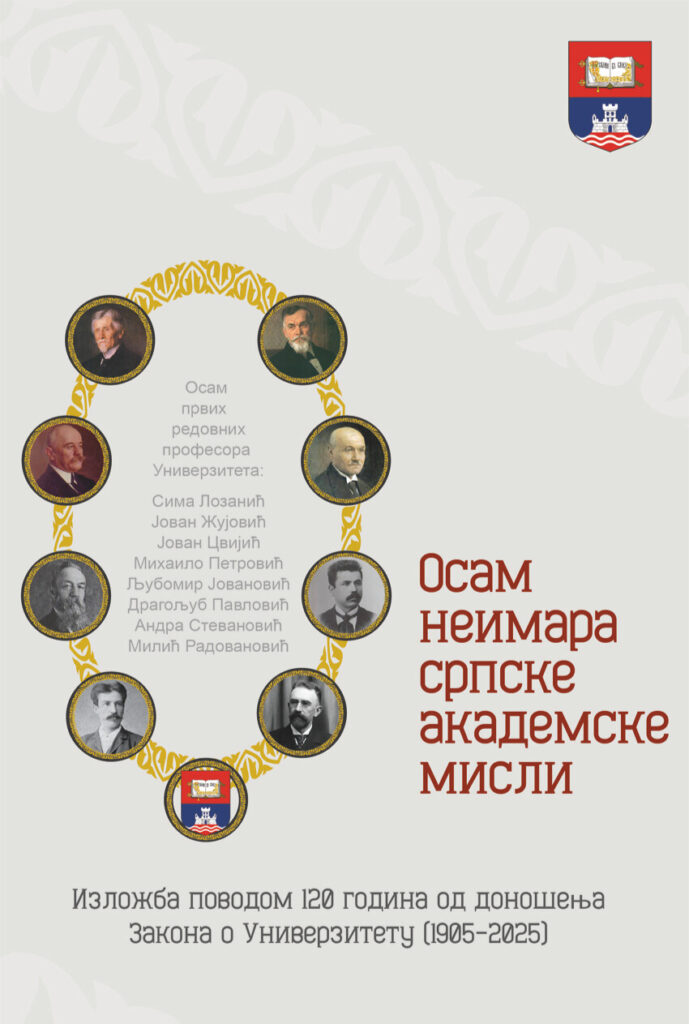
The introductory section of the catalog (24 pages) includes the following chapters: Introduction, Per aspera ad scientia, Organization of the University, The University Act, The First Eight Full Professors of the University of Belgrade, Selected Bibliography on the Lyceum, the Great School, and the University. The main section of the manuscript, entitled ‘Eight Founders of Serbian Academic Thought,’ comprises biographies of the first full professors: Sima Lozanić (Early Life and Education, Academic and Pedagogical Work, Textbooks, Work in Applied Chemistry, Public Service and Contribution to the Development of the Serbian Economy, The First Rector of the University of Belgrade, True Patriot, Honors, The Departure of “the Spirit Stronger than Matter” into Eternity, 24–38); Jovan Žujović (Childhood and Education, Pedagogical, Scientific, and Social Engaged Achievements, On the Political Stage, Honors, The Passing of a Serbian Geologist, Social and Political Writings, 39–51); Jovan Cvijić (Childhood and Education, Teaching Career and Pioneering Work, Serbian Geographical Society, Scientific Research and Fieldwork, Anthropogeography and Ethnological Research, Social and National Endeavors, Testimonies of Prestige and Accomplishments, Final Years and Legacy, Editorial Work, 53–69); Ljubomir Jovanović (Childhood and Education, Pedagogical and Scientific Career, Political and Public Engagement, Initiator and Participant in the Cultural Life of Serbia, 71–78); Mihailo Petrović Alas (Early Life and Education, Academic and Pedagogical Career, From Theory to Practice: Inventions, In Service to His Country, Formulas on the River and in the Fishing Net, Adventurer, Travel Writer and Musician, Emblems of Reputation, Into Eternal Sleep Carried by Fishermen, 79–94); Dragoljub M. Pavlović (Life and Education, Pedagogical and Scientific Work, Public and Political Activity, 95–100); Andra Stevanović (Education and Pedagogical Work, Architect of Lasting Cultural Value, Between the Spirit of the Times and the Roots of the People, 101–107); Milić J. Radovanović (Life and Endeavors, Teaching and Scientific Work, Government Service, Translations, 109–114). For each professor, the literature consulted and a selected bibliography are provided.
The founding of the first Serbian university represents one of the most significant cultural and social events in our history. The anniversary commemoration and remembrance of its founders and first professors provides an opportunity to present to the wider public their importance in establishing modern science and culture in Serbia, during a time marked by the most prolific and versatile Serbian scholars. The period of the final decades of the 19th century and the early years of the 20th century represents a unique era in which the professors featured here laid the foundations for most sciences in our country, established the first scientific and professional institutions, trained a new generation of scholars, and thereby brought Serbia into the fold of modern European nations. While in developed European states individual sciences were advanced by teams of specialists, in small Serbia there were no conditions for more than one professor per scientific discipline. Each individual had to develop an entire science on their own, conduct research, write textbooks, publish papers in foreign journals to introduce Europe to our knowledge and achievements, train the next generation, and launch academic journals. Such individuals, rightly chosen as the first university professors, educated at the finest European schools and great patriots besides, had to assist the state by working on various political tasks in addition to their teaching and scientific work, and participate in all the wars of their time.
These first eight professors also represented the first eight university chairs with all the subjects each encompassed: Sima Lozanić represented the entire field of chemistry (inorganic, organic, applied, chemical technology), and several of his works on organic chemistry and electrochemistry are still cited today; Jovan Cvijić, at the time the foremost expert on the Balkan Peninsula, was primarily a physical geographer and geomorphologist, but also dealt with questions of geology, anthropogeography, ethnology, and ethnopsychology; Jovan Žujović, founder and establisher of geological science in Serbia, conducted geological studies of Serbia but also produced works on paleontology, archaeology, and anthropogeology; Mihailo Petrović Alas, founder of the Belgrade mathematical school, whose results in differential equations entered world mathematical literature and textbooks, established two new disciplines: mathematical phenomenology and the theory of mathematical spectra; Ljubomir Jovanović studied the history of the Serbian people—the period before the Nemanjić dynasty, the era between the Battle of Maritsa and the political collapse in the 15th century—but also engaged with medieval Bosnian history. He is credited with the final triumph of the critical approach in Serbian historiography. Dragoljub Pavlović dealt with general as well as national history of the 18th and 19th centuries, studying administrative and ecclesiastical policy, finance, and economy. He introduced systematic research of domestic and foreign archival materials and advanced Serbian historical methodology; Andra Stevanović, an architect, cultivated a national style based on Serbian medieval architecture. A large number of his buildings have been designated as cultural monuments, retaining lasting cultural value; Milić Radovanović established economic thought and shaped the country’s financial policy.
Through their immense scholarly work and their broad and multifaceted creative output, these first professors of the University represented the most influential Serbian intellectuals who, through their knowledge and authority, established and shaped the University of Belgrade.
The authors have presented the extensive and diverse scientific and pedagogical work, as well as the socio-political activities of each individual, expertly and concisely, without neglecting any of the numerous activities they undertook, while simultaneously emphasizing their significance—both contemporary and future—for the country’s science and culture.
The authors of the catalog have fully succeeded in presenting the significance and greatness of our first full university professors who ‘shaped Serbian academic thought,’ and in reflecting, through their diverse scientific and professional work, the era and the scientific and professional atmosphere of the late 19th and early 20th centuries that enabled the founding of the most important Serbian institution—the establishment of the first Serbian university, which to this day remains a pillar of our culture and science. For this reason, I recommend the catalog manuscript for publication with great satisfaction.
Belgrade, May 13, 2025
With respect,
Snežana Bojović